Multi-entity AP automation is the practice of running a consistent, governed accounts payable workflow across multiple legal entities, each with its own accounting system, GL structure, and approval rules, on a single platform. For ANZ groups running Xero or MYOB across multiple companies, it’s the difference between AP that scales and AP that fragments with every acquisition.
Managing AP across multiple entities should be a structured, repeatable process. For most ANZ businesses running Xero or MYOB across multiple companies, it’s anything but.
The construction group comprises a holding company, a plant hire subsidiary, and a project management entity. The hospitality group has four venue companies sharing central purchasing relationships. The franchise network has twenty franchisees, each running their own books but dealing with overlapping supplier relationships. In every case, the problem is the same.
Invoices arrive referencing the wrong entity. Each company has developed its own approval rules and managing them separately means errors accumulate at the boundaries. Finance leaders responsible for more than one entity are navigating between systems, chasing approvals across different inboxes, and manually assembling a picture of the group’s AP position.
AP automation for multi-entity groups addresses this by giving each legal entity its own structured, governed AP process, built on the same platform and the same workflow framework but configured for each entity’s specific rules. Here’s what that looks like in practice.
Why Multi-Entity AP Becomes Unmanageable
The problems that arise when a business moves from a single entity to multiple entities are predictable, and they grow with each additional entity. In our experience with ANZ mid-market clients, the failure modes are consistent:
- Each entity has its own approval rules, thresholds, and delegation structures, and without a shared platform, those rules live in people’s heads, email chains, and informal conventions rather than an enforced process. What works for a $5m subsidiary looks nothing like the controls needed for a $50m group company.
- Suppliers invoice the wrong entity. A supplier working across multiple companies in a group often invoices whichever entity they most recently dealt with. Rerouting those invoices manually and reconciling the resulting mismatches is a recurring overhead with no clean solution in a manual environment.
- Finance leaders lose visibility when they move between entities. Without a consistent AP platform across the group, understanding what’s approved, what’s outstanding, and what’s at risk in each entity requires logging into separate systems and manually assembling the picture.
- Month-end is held together by individuals. When AP oversight across entities depends on one person knowing where all the pieces are, the business is one resignation or leave period away from a delayed close.
- Approval controls weaken as the organisation grows. Informal approval structures that worked at two entities stop working at five. Without automated routing and threshold enforcement, the gap between stated policy and actual practice widens with every entity added.
The result is slow approvals, approval gaps, inconsistent coding, and a finance team spending more time navigating between processes than working within one. AP automation doesn’t collapse all of this into a single system; each entity stays its own operation. But it gives every entity the same governed workflow.
How Acume Works for Multi-Entity Groups
Acume’s approach to multi-entity AP reflects how groups operate: as a collection of legally separate entities, each with its own accounting system, chart of accounts, and operational rules, yet sharing people, oversight responsibilities, and a common interest in consistent governance.
Rather than consolidating entities into a single unified view, Acume creates a separate account for each legal entity. Each account connects to that entity’s accounting system, whether Xero, MYOB, or another ERP, and runs the same AP workflow framework. Users responsible for multiple entities can navigate between accounts within the same platform, without logging into separate systems or switching tools.
This matters because it respects the reality of multi-entity finance. The chart of accounts for each entity is mastered in that entity’s ERP; Acume doesn’t override it or try to normalise it across entities. Each entity’s coding structure, GL codes, and tax logic are drawn from its own accounting system.
1. Same Workflow Framework, Separate Entity Accounts
Every entity in a group gets its own Acume account, connected to its own accounting system. Each account runs the same AP workflow: invoice ingestion, auto-coding against that entity’s own GL structure, approval routing, and ERP export. The workflow is consistent; the configuration reflects each entity’s own rules.
For finance leaders responsible for multiple entities, this means a consistent process to work within, regardless of which entity they’re managing. For group owners or CFOs with access across multiple accounts, switching between entities is a navigation step rather than a system change; the same platform, the same interface, a different entity’s configuration.
2. Approval Workflows Configured Per Entity
Each Acume account carries its own approval workflow configuration. An entity can define its own approval thresholds, supplier-specific routing rules, and delegated authority structure, independently of any other entity in the group.
Acume’s business rules come configured out of the box, built on AP best practices and ready to apply without custom development. Each entity starts from that proven baseline and adjusts to its own context: the thresholds that align with its financial authority policy, the approval tiers that reflect its management structure.
In practice, this means a $10,000 invoice at one entity routes according to that entity’s authority limits and management hierarchy, while the same supplier’s invoice at a different entity routes completely differently, because that entity has its own configuration. There’s no spillover between accounts. Every approval action is logged within that entity’s account: who approved, when, at what amount, creating an audit trail that satisfies both internal governance requirements and external audit scrutiny for each entity independently.
3. Cross-Entity Access for Finance Leaders
For the financial controller or group finance manager responsible for multiple entities, the practical challenge in a manual environment isn’t just process; it’s visibility. What’s outstanding at each entity? What’s awaiting approval? Where are the exceptions? Getting that picture requires logging into separate systems and manually assembling data.
In Acume, users with access to multiple entity accounts can navigate between them directly within the platform. There’s no separate login for each entity, no context-switching between systems, no manual data assembly. A finance leader responsible for three entities can move between accounts, review the AP position at each, and act on exceptions, all within a single session.
This doesn’t replace entity-level accounting or consolidation, which happens in each entity’s ERP. What it does is give the people responsible for multiple entities a consistent, accessible view of the AP process across all of them, without the friction of navigating between completely different environments.
4. Consistent AP Process Across Different Accounting Systems
One of the practical realities of multi-entity groups, particularly those that have grown through acquisition, is that not every entity runs the same accounting system. One company might be on Xero. Another on MYOB. A third on an older ERP.
Acume connects to each entity’s accounting system independently. The AP workflow, ingestion, coding, approval routing, and ERP export are the same for each entity regardless of which system sits behind it. Each entity’s account pulls its suppliers, GL codes, and tax logic from its own accounting system.
For groups where different entities are on different platforms, this means AP automation doesn’t require standardising the accounting stack first. Each entity can be onboarded to Acume on its own timeline, connecting to whatever system it already uses.
eInvoicing Across Multiple Entities: The 2026 Consideration
There’s a forward-looking dimension to multi-entity AP automation that ANZ finance teams need to factor in now: eInvoicing.
Australia’s eInvoicing mandate, built on the Peppol network, is expanding toward 2026 compliance deadlines. For multi-entity groups, the transition is more complex than for single-entity businesses. Different entities within a group are likely to have different supplier mixes, different compliance timelines, and potentially different access point requirements depending on their industry and customer base.
Acume supports both PDF and Peppol eInvoice ingestion natively within each entity account. Both formats route into the same approval and coding workflow for that entity; there’s no separate eInvoicing process to configure per entity, and no risk that one entity’s compliance position creates a workflow problem for another. As each entity’s suppliers register on the Peppol network, their eInvoices begin arriving alongside PDFs without any process change.
Why Multi-Entity AP Automation Is Non-Negotiable for Growing Groups
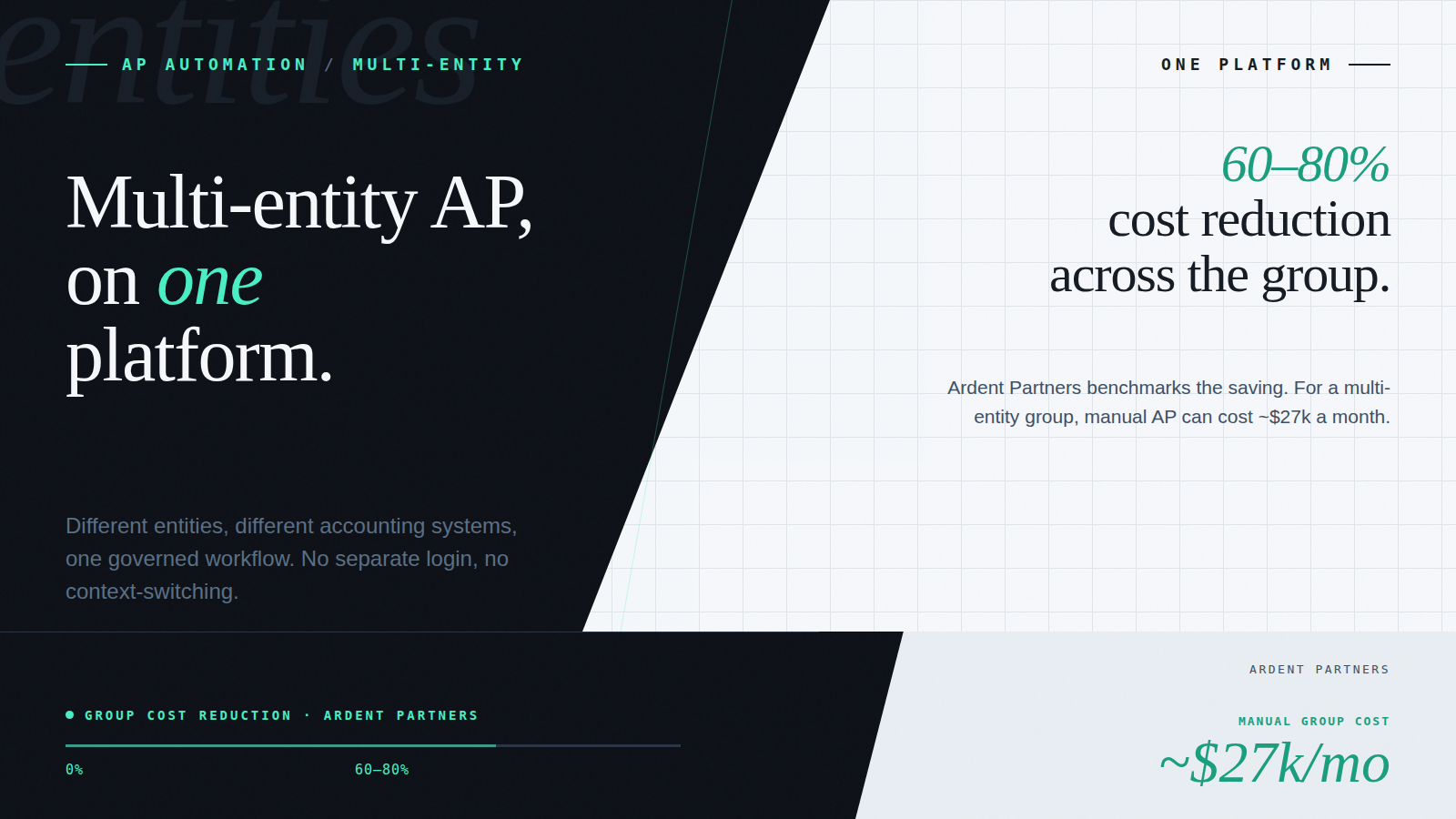
Ardent Partners’ State of ePayables research found that organisations using AP automation achieve 60–80% cost reductions versus manual AP environments, and for multi-entity groups, applying that gain across every entity multiplies the return significantly.
The cost of inaction is concrete. The ATO benchmarks paper invoice processing at around $30 per invoice and PDF invoicing at around $27. A group processing 1,000 invoices per month across four entities is spending at least $27,000 per month on invoice processing alone, before accounting for the approval overhead, reconciliation errors, and audit preparation time that manual multi-entity AP generates.
Beyond direct cost, the structural problems compound with growth:
- Manual processes do not scale. Every new entity, every new approval tier, every new supplier adds overhead to a process that was already stretched. Groups that delay automation find that each acquisition makes the problem harder, not easier.
- Finance leader visibility degrades as entity count grows. Without a consistent platform, understanding the AP position across a growing group requires more manual effort per entity, not less. The people with multi-entity responsibility feel this most acutely.
- Approval controls weaken as the organisation grows. Informal structures that worked at two entities stop working at five. The gap between what the policy says and what happens widens with each entity added.
- Audit readiness suffers. When each entity runs a different AP process under different documentation standards, preparing for an audit means reconstructing each entity’s approval history from whatever records were kept. Consistent, automated AP means the audit trail exists by default.
Conclusion: One Framework, Every Entity
Multi-entity AP doesn’t require collapsing every entity into a single process. Each legal entity is its own operation, with its own accounting system, chart of accounts, and governance requirements. What multi-entity groups need is a consistent workflow framework that applies to each entity appropriately. enforcing the right rules for each entity, giving finance leaders visibility across all of them, and building in the compliance readiness that the 2026 eInvoicing mandate requires.
For ANZ groups running Xero, MYOB, or a mix of platforms across entities, Acume provides that framework. Each entity gets its own account, connected to its own accounting system, running the same workflow. Finance leaders with responsibility across multiple entities navigate between accounts within one platform. The audit trail exists for every entity, independently and consistently.
The goal isn’t uniformity. It’s consistent, auditable, governed AP — applied to every entity, respecting what makes each one different.
Ready to Bring Multi-Entity AP Under Control?
Acume works with ANZ mid-market groups to implement AP automation across every entity, whether you’re running multiple Xero organisations, MYOB companies, or a mix of accounting systems. If multi-entity AP complexity is slowing your finance team down, we’d like to help.
Contact us to talk through your multi-entity AP setup with our team.
Frequently Asked Questions
What is multi-entity AP automation?
Multi-entity AP automation is the practice of running a consistent, governed accounts payable workflow across multiple legal entities, each with its own accounting system, GL structure, and approval rules, on a single platform. Each entity retains its own configuration, suppliers, and audit trail; the platform provides a shared workflow and cross-entity visibility for finance leaders responsible for multiple companies.
How does AP automation work across different accounting systems in a group?
A multi-entity AP platform connects to each entity’s accounting system independently, Xero, MYOB, or a legacy ERP, pulling GL codes, tax logic, and supplier data from each system separately. The AP workflow (invoice ingestion, coding, approval routing, ERP export) is the same across all entities; only the configuration differs. Groups where entities run different accounting systems can onboard each entity on its own timeline without standardising the underlying stack first.
Can each entity in a group have different approval rules and thresholds?
Yes. In Acume, each entity account carries its own approval workflow configuration, thresholds, delegation hierarchies, and supplier-specific routing rules, independently of every other entity in the group. A $10,000 invoice is routed according to one entity’s authority limits, while the same invoice at a different entity is routed completely differently. There’s no spillover between accounts.
How does multi-entity AP automation help with audit readiness?
When each entity runs a different manual AP process, preparing for an audit means reconstructing approval histories from email chains, spreadsheets, and whatever records were kept, a time-consuming exercise with gaps. With a governed multi-entity platform, every approval action is logged automatically: who approved, when, at what amount, for which entity. The audit trail exists by default for every entity, consistently and independently.
How does eInvoicing affect multi-entity AP automation in Australia?
Australia’s eInvoicing mandate, built on the Peppol network, is expanding toward 2026 compliance deadlines. For multi-entity groups, the compliance transition is more complex than for single-entity businesses, different entities may have different supplier mixes and compliance timelines. A platform that supports both PDF and Peppol eInvoice ingestion natively within each entity account handles this without a separate eInvoicing project per entity.
A demo on your actual workflow.
A live walkthrough using real data – the capture, the coding, the approval routing – and how it sits inside the AP workflow you already run. No slideware.