It starts innocuously enough. A supplier invoice arrives, someone forwards it to the relevant manager and back comes a reply: “Approved.” The AP team processes it. Everyone moves on.
It’s fast. It’s familiar. It works. Until it doesn’t.
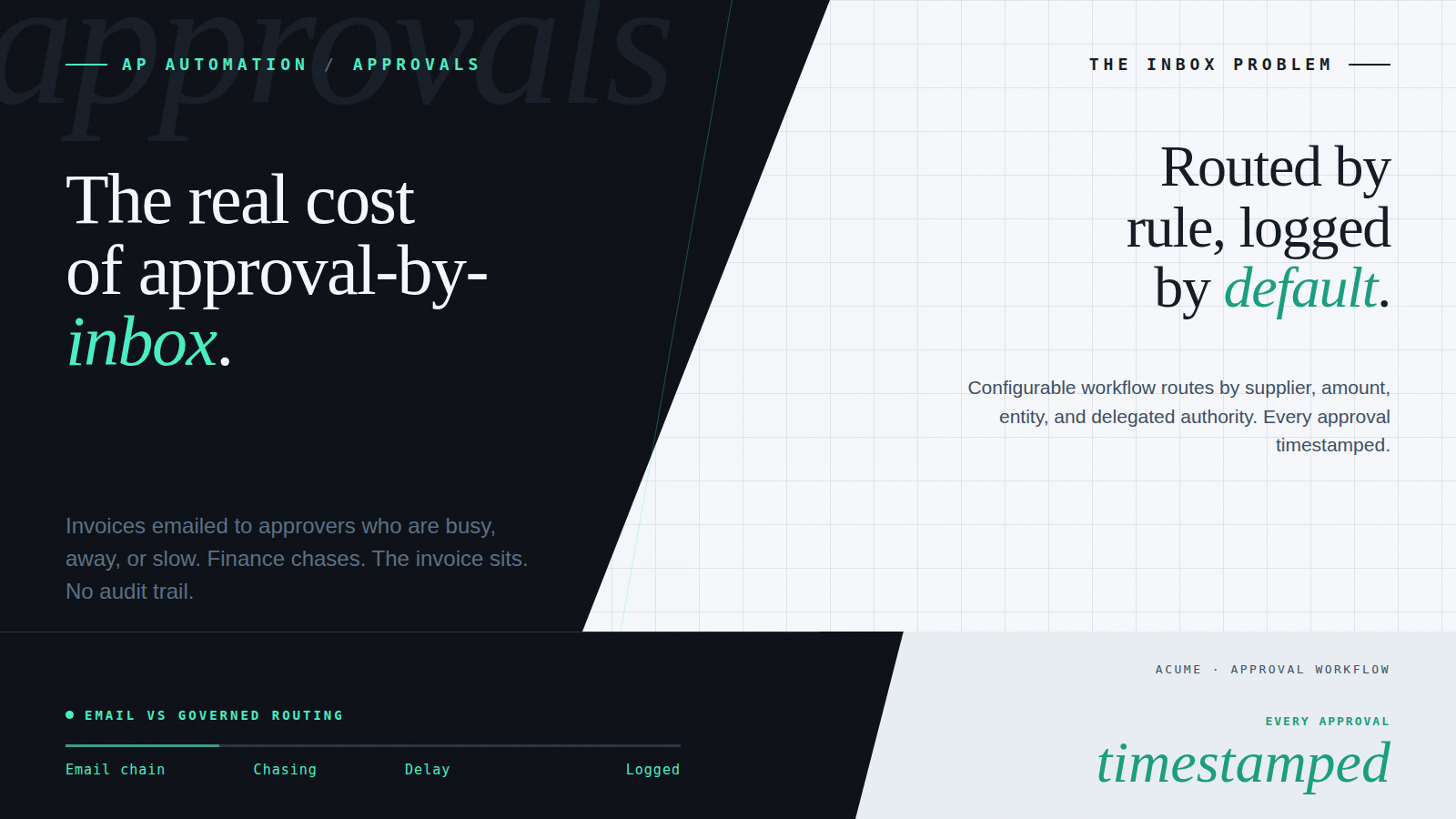
Invoice approval workflow automation is the practice of automatically routing supplier invoices to the correct approvers based on pre-configured rules; value thresholds, GL code, department, or delegated authority, with every action timestamped, linked to the original invoice, and recorded in a tamper-proof audit trail. It’s what replaces the email chain.
That chain of emails; the forwarded PDF, the quick reply, the AP team manually ticking it off, is not a process. It’s a workaround masquerading as one. And for many Australian and New Zealand businesses, it’s quietly accumulating risk in the background: financial, operational, and reputational.
This article breaks down exactly what that risk looks like, what it costs in real terms, and why switching to a structured approval workflow is one of the highest leverage changes a finance team can make, ideally before volume, growth, or an auditor forces the issue.
Email Approvals Aren’t a System – They’re a Communication Channel Doing a Workflow’s Job
Most businesses don’t design email into their AP process. It just happens. The business is small, decisions move quickly, and “just flick me the invoice” is easier than building something formal.
The problem is that email is built for communication, not control. Once an approval moves into the inbox, everything that should happen automatically becomes manual:
- Someone has to extract the approval and attach it to the invoice record
- There’s no validation that the approver had delegated authority for that amount
- There’s no timestamped, tamper-proof audit trail
- Messages get missed, misfiled, or buried under three weeks of other email
- If something goes wrong, there’s no structured way to trace where the breakdown occurred
It might hold together at 50 invoices a month. At 200, it starts to strain. At 500, it breaks. And when it breaks, the consequences are no longer just inefficiency.
What Approval Bottlenecks Actually Cost: The $15–$40-Per-Invoice Problem
“Hey John, can you approve this one? It’s the fitout invoice from the Parramatta supplier, ~$18k.”
[Four days pass. Month-end is tomorrow.]
“Hi John, just circling back on that invoice approval – we’re about to close the month.”
John is the national operations manager. He’s in back-to-back site meetings. The AP team has now spent 40 minutes chasing one invoice approval across three emails and a text message. Multiply that by the 23 invoices awaiting sign-off in the same inbox, and you have a full day of reactive admin – for one person, every month.
The numbers bear this out. Industry benchmarks from Ardent Partners consistently find that organisations processing invoices manually spend between $15 and $40 per invoice in fully-loaded labour costs, compared to $2–$5 for organisations with automated AP workflows. For a business processing 300 invoices a month, that gap represents $3,000–$10,500 in avoidable cost. Every month.
Email approvals are not free. They just hide the cost in people’s time.
Multi-Step Approvals and the Visibility Black Hole
Invoice approval workflows rarely involve just one person. Most businesses have tiered approval thresholds: invoices under $5,000 go to a department head, over $5,000 to the CFO, over $50,000 to the board. Capital expenditure is treated differently from operating expenditure. Project spend has different rules.
In a structured system, these rules are built in. Invoices route automatically based on GL code, value, department, or project. Finance can see, at a glance, where every invoice is in the approval chain.
In an email system, finance has no idea. They can’t tell whether an invoice is:
- Waiting for a first approver who hasn’t opened the email yet
- Stuck midway through a two-step process
- Approved weeks ago, but never actioned by AP because the email was missed
- In dispute, with no record of what was disputed or why
For businesses operating across multiple entities, cost centres, or states, this is not just inconvenient, it’s a governance gap. Approvals are part of your internal controls. When auditors review your accounts, “we got it via email” is not an answer.
The Audit Trail Gap: What “We Got It via Email” Looks Like Under Scrutiny
When an ATO audit or external review examines AP records, they’re looking for an unbroken chain of evidence: who approved what, when, under what authority, linked to the original invoice and payment.
With a structured AP system, that chain is automatic and complete. With email, it’s typically reconstructed after the fact from screenshots, forwarded chains, and someone’s memory.
An email-based audit trail looks like:
- A screenshot of an email reply reading “Yep approved” with no amount specified
- A PDF attached to an email that no longer exists in the original thread
- A verbal recollection: “John approved it last month, I think it was the 14th”
- A forwarded email chain that spans three inboxes, two of which belong to people who’ve since left the business
A proper AP audit trail records who approved, exactly when, under which delegation rule, linked directly to the original invoice and the payment transaction. Not because it’s nice to have, because that’s what financial governance requires.
When Weak Approvals Meet Business Email Compromise: A Pattern the ACCC Keeps Reporting
The ACCC’s (Australian Competition and Consumer Commission) Scamwatch data has consistently identified Business Email Compromise (BEC) as one of the most financially damaging scam types targeting Australian businesses, responsible for hundreds of millions of dollars in losses annually, with small and medium businesses disproportionately affected.
The mechanism is well documented. A fraudster gains access to, or spoofs, a supplier’s email address. They send a plausible invoice or bank account update request. An employee, following the same informal email-based process they use for every other approval, processes it. The money moves before anyone notices.
A composite example drawn from the pattern in ACCC reports: a national services business receives what appears to be a routine invoice from a regular supplier. It’s forwarded for approval via email. The department head replies “approved.” AP processes it against a bank account that was silently updated in the supplier record three weeks earlier by someone with email access to that supplier’s domain. The payment clears. The fraud isn’t discovered until the real supplier follows up on an unpaid invoice.
Structured AP systems address this directly. Vendor bank details are locked and change controlled. Invoices are matched against purchase orders and historical payment records. Anomalies trigger escalation, not silent processing. An informal email approval workflow has none of these safeguards.
Why Businesses Don’t Fix It – and What Finally Changes That
The businesses most exposed to email approval risk are not, in most cases, poorly run businesses. They’re fast-moving ones. The process was never a deliberate choice, it’s what grew up in the absence of one.
The reasons for not changing it are predictable:
- It’s what everyone knows how to use
- There’s a fear that a “formal system” means more process, not less
- The business hasn’t hit a compliance event or fraud incident yet
- It feels “good enough” for the current volume
The tipping point is almost always one of four things: volume that makes the manual process unsustainable; a compliance event (an audit, a dispute, a payment error) that exposes the gaps; a new CFO or financial controller who arrives and immediately recognises the risk; or a fraud event.
By that point, the cost of fixing it is higher than it needed to be, because the business is now reacting, not planning.
What Invoice Approval Workflow Automation Actually Looks Like for Mid-Market Businesses
Modern AP automation for mid-market and growing businesses is not the enterprise ERP implementation of fifteen years ago. It’s not slow, expensive, or complex to deploy. And it does not add process, it replaces manual steps with automatic ones.
A structured invoice approval workflow should:
- Route invoices automatically based on value thresholds, GL code, department, or project, without a human having to decide where it goes
- Enforce delegated authority rules, so only the right people can approve at each level
- Give finance instant visibility on every invoice in the approval queue, not a chase, a dashboard
- Create a complete, timestamped audit trail automatically, linked to the original invoice and payment
- Integrate with Xero, MYOB, and other accounting systems so reconciliation happens without double-entry
- Allow approvals on mobile, so an approver in the field doesn’t create a bottleneck for the AP team
That’s what Acume is built for, not to add layers of bureaucracy, but to automate the parts that currently depend on someone remembering, chasing, and manually recording things that a system should handle. Finance stays in control. The business moves faster. And the audit trail exists by default, not by reconstruction.
There’s also a forward-looking reason to get approval workflows on a governed platform now. Australia’s eInvoicing mandate, built on the Peppol network, is expanding toward 2026 compliance deadlines. As more suppliers register on Peppol and structured eInvoices begin arriving alongside PDFs, the AP workflow needs to handle both formats through the same approval and audit process, without a separate compliance project running in parallel. Businesses that build a governed approval workflow now are positioned for eInvoicing readiness; those still running email approvals will face two problems at once.
The Bottom Line: Finance Leaders Should Set the Standard, Not Wait for the Crisis
Finance teams are not in the business of processing invoices. They’re in the business of protecting cash flow, ensuring governance, and enabling business decisions. But that’s only possible when the infrastructure underneath is sound.
An email-based approval process is not sound infrastructure. It’s a gap in internal controls that grows with volume, creates material fraud exposure, and will eventually cost more to fix under pressure than it would have cost to address proactively.
Switching from email-based AP to structured invoice approval workflow automation is one of the highest-ROI changes a finance leader can make. The cost of implementation is modest. The cost of not implementing it is hidden, until it isn’t.
Don’t wait for the audit, the fraud incident, or the CFO who arrives and immediately asks why approvals still happen via email. Fix it before it becomes a crisis, and let finance lead from the front.
→ See how Acume’s invoice approval workflows work – book a demo or explore how it integrates with Xero and MYOB.
Frequently Asked Questions
What is invoice approval workflow automation?
Invoice approval workflow automation is a system that automatically routes invoices to the right approvers based on predefined rules; value thresholds, department, GL code, project records each approval with a timestamp and authority reference, and integrates the completed approval directly into the accounting system. It replaces the email chain with a governed, auditable process that runs without manual intervention.
How much does manual invoice approval cost per invoice?
According to Ardent Partners’ annual AP research, manually processed invoices cost organisations $15–$40 each in fully-loaded labour costs. Organisations with automated AP workflows process the same invoices for $2–$5. For a business handling 300 invoices per month, that’s a potential saving of $3,000–$10,500 per month, before accounting for fraud prevention, faster month-end close, and audit exposure reduction.
Why is email invoice approval a fraud risk?
Email-based approval workflows lack the controls that prevent Business Email Compromise: vendor bank detail validation, invoice-to-PO matching, anomaly detection, and a locked change-control process for supplier payment information. When approvals happen via email reply, there is no system check, only a human who may not notice that a bank account was recently changed or that the invoice reference doesn’t match a purchase order.
What is an AP audit trail and why does it matter?
An AP audit trail is a complete, timestamped record of every approval action taken on an invoice: who approved it, when, under what delegated authority, and how it links to the original invoice and payment transaction. It is required for internal controls, external audits, dispute resolution, and ATO compliance. An email-based process cannot produce this reliably, a structured AP platform creates it automatically on every transaction.
A demo on your actual workflow.
A live walkthrough using real data – the capture, the coding, the approval routing – and how it sits inside the AP workflow you already run. No slideware.