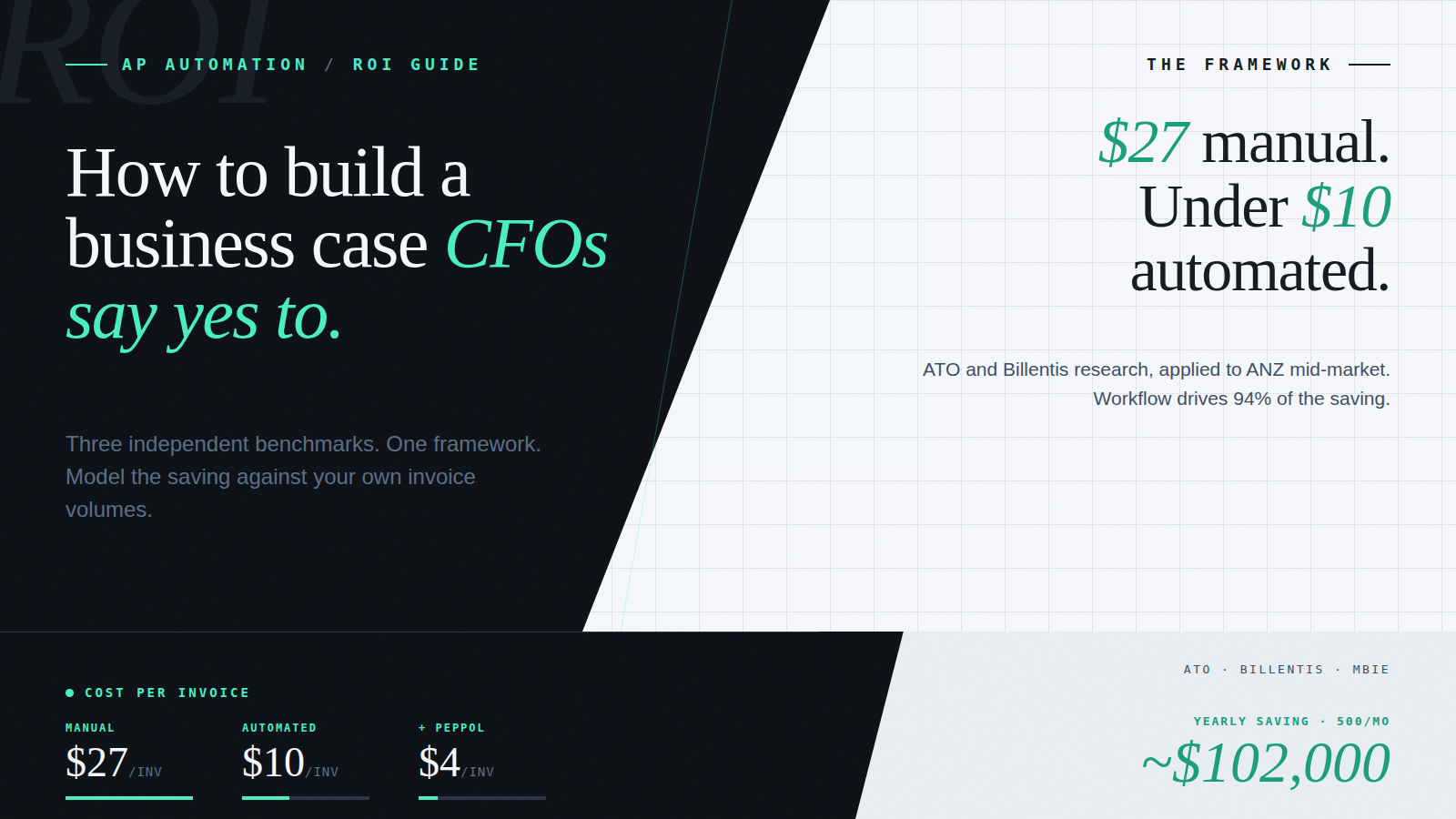
Most AP automation projects that don’t get approved fail not because the CFO doesn’t believe in the technology, but because the CFO doesn’t believe in the project. They fail because nobody put a credible number in front of them.
The AP manager knows the process is broken. They feel it every month-end, every time they chase an approval, every time a duplicate payment surfaces in the reconciliation. But that accumulated frustration doesn’t translate naturally into the language a CFO needs to approve a project: a cost, a saving, a payback period.
The challenge is that manual AP costs are genuinely diffuse. They don’t appear as a single line item. They’re spread across staff time, error correction, late-payment penalties, audit preparation, and quiet fraud exposure, which most businesses don’t quantify until something goes wrong. That’s why the business case keeps getting deprioritised, not because it’s weak, but because nobody has assembled it.
This guide does that. It provides benchmark data, the correct interpretation of what the numbers represent, and the business-case structure that lets finance leaders make the case with confidence.
What Manual AP Actually Costs: Understanding the Benchmark
Three independent sources have reached near-identical conclusions on the cost of manual invoice processing:
- Australian Taxation Office: ~$30 to process a paper invoice, ~$27 for a PDF invoice processed manually, under $10 for a structured Peppol eInvoice. These benchmarks represent the fully-loaded cost across all handling steps.
- New Zealand’s Ministry of Business, Innovation and Employment (MBIE): NZD $28–$30 for a manually processed PDF invoice, versus NZD $7–$9 for a structured eInvoice.
- Billentis global research: $25–$35 per invoice for manual processing, with electronic and automated invoice processing reducing costs by 60–80%. Billentis is the leading independent analyst for the global e-invoicing market; their business case research was commissioned by the Australian Taxation Office in 2015 and has been updated through 2019.
- Ardent Partners State of ePayables: $15–$40 per invoice in fully-loaded labour costs for manually processed invoices, compared to $2–$5 for organisations with automated AP workflows. Ardent Partners conducts annual AP benchmarking research across hundreds of organisations globally.
Note on sources: The ATO ($27), MBIE ($28–$30), Billentis ($25–$35), and Ardent Partners ($15–$40) benchmarks all measure the same thing, the total fully-loaded cost of processing an invoice manually through all AP steps, including coding, approval, matching, and archiving. They are corroborating studies from different geographies and methodologies, not separate cost layers. Use the ATO benchmark as the ANZ anchor; the others confirm it is consistent with global research.
Before using these numbers in a business case, it’s important to understand what they actually measure, because the 60–80% savings figure is frequently misread, significantly understating the real ROI.
Where the Cost Actually Lives: What the Billentis Research Shows
The Billentis Business Case E-Invoicing / E-Billing report (2017) contains a detailed cost breakdown for invoice recipients based on actual customer data. It is the most precise publicly available decomposition of what manual AP processing actually costs, and what automation actually saves. The breakdown is shown below, translated from euros to reflect the same proportional structure.
Cost component — Paper invoice (manual) — Electronic + automated — Where the saving comes from
Receive / capture — ~6% of total cost — Third-party network cost (~$0.10–$1.00) — Elimination of manual receipt, printing, scanning, and data entry
Entering / codification — ~17% of total cost — Eliminated entirely — Automated coding rules replace manual GL allocation
Validation & matching — ~23% of total cost — ~7% of total cost — Automated PO matching and exception flagging
Dispute management — ~14% of total cost — ~11% of total cost — Structured workflow reduces dispute cycles
Payment & cash management — ~27% of total cost — ~11% of total cost — Automated approval routing and payment scheduling
Archiving — ~13% of total cost — ~5% of total cost — Digital archive replaces physical filing
Total saving — 100% (baseline) — ~64% reduction — 94% of saving from workflow; 6% from capture
Source: Billentis, Business Case E-Invoicing / E-Billing (2017), Figure 7 — Saving potential for invoice recipients, actual customer case. Proportions preserved; absolute figures from European research in EUR. ATO and MBIE benchmarks confirm comparable fully-loaded costs in the ANZ market.
The table makes two things clear that are consistently obscured in discussions about eInvoicing ROI.
First, workflow automation accounts for approximately 94% of the savings. The cost components that automation eliminates or dramatically reduces, including entering and codification, validation and matching, dispute management, payment routing, and archiving, account for the vast majority of the $27 paper benchmark. The manual receive-and-capture step accounts for only around 6% of the total cost.
Second, the Billentis 60–80% figure represents the combined savings from electronic receipt plus full workflow automation, not eInvoicing alone. The same Billentis research is unambiguous on this point: the saving is achieved through ‘electronic AND automated invoice processes.’ Receiving a Peppol eInvoice eliminates the capture step; it does not automatically eliminate the workflow cost. A business that connects to Peppol but continues to process invoices manually will still incur most of the original $27 cost, except for the scanning and data entry steps.
The Numbers Applied to Your Business
Applied to representative ANZ mid-market invoice volumes, the workflow automation saving alone, before factoring in eInvoicing, produces a compelling annual figure:
Monthly volume — Manual cost (~$27/invoice) — Automated cost (~$10/invoice) — Monthly saving — Annual saving
200 invoices — $5,400 — ~$2,000 — ~$3,400 — ~$40,800
500 invoices — $13,500 — ~$5,000 — ~$8,500 — ~$102,000
1,000 invoices — $27,000 — ~$10,000 — ~$17,000 — ~$204,000
Based on ATO benchmark for manual PDF processing (~$27/invoice) and Billentis research confirming 60–80% cost reduction through electronic and automated processing. Automated cost uses $10/invoice as a conservative mid-point consistent with the Billentis breakdown. Actual results vary by invoice complexity, platform, and volume. Figures in AUD.
For businesses with Peppol-registered suppliers, eInvoicing eliminates the capture step for those invoices, reducing per-invoice costs to the $3–5 range. As Peppol adoption grows across the ANZ supplier base toward the 2026 mandate expansion, that proportion increases over time, compounding the workflow automation savings.
Where the ROI Goes Beyond Processing Cost
The processing cost saving is the most quantifiable part of the business case and the right place to start. Three additional layers materially strengthen it.
Error correction and duplicate payments
In manual AP environments, duplicate payment prevention depends entirely on the AP team checking invoice numbers and amounts against prior payment runs. One missed check is a duplicate payment. GL coding errors surface at month-end when the reconciliation overhead is highest. As the Billentis research confirms, typically 20–30% of all manually processed invoices require exception handling in one form or another, each exception adding significant cost beyond the base processing benchmark. Ardent Partners’ State of ePayables research confirms that organisations achieving high automation rates see materially lower error and exception rates.
Approval bottlenecks and payment delays
Even within the $27 benchmark, approval labour is the largest single cost component. In manual environments, invoices wait in inboxes while approvers are unavailable, finance chases sign-off, and month-end brings a backlog of items that should have cleared weeks earlier. Ardent Partners’ research confirms the scale of this: organisations running manual AP pay $15–$40 per invoice in fully-loaded labour costs, while organisations with automated workflows process the same invoices for $2–$5. The $12–$25 per-invoice gap between those two figures is almost entirely approval and workflow labour, the same cost the Billentis breakdown attributes to codification, validation, matching, and payment management. Automation that eliminates manual approval routing and replaces email chains with structured workflows is where most of that gap closes.
Fraud exposure
The ACCC’s (Australian Competition and Consumer Commission) Scamwatch data consistently identifies Business Email Compromise as one of the most financially damaging scam types targeting Australian businesses. The attack vector in almost every documented case is an informal approval process: a fraudster spoofs a supplier’s email address, sends a plausible bank account update or invoice, and the payment clears because the approval workflow lacks an automated validation step. Structured AP systems address this directly: supplier bank details are change-controlled, invoices are matched against verified supplier records, and anomalies escalate before payment rather than after. The cost of a single BEC incident at mid-market scale typically exceeds the annual cost of the AP automation platform that would have prevented it.
eInvoicing and the 2026 Mandate: The Compliance Dimension
Australia’s eInvoicing mandate, built on the Peppol network, is expanding in stages. Federal government agencies are already required to receive Peppol eInvoices. Government suppliers are progressively coming into scope. The broader B2B business community is following, with further compliance stages expected toward 2026.
The mandate adds a compliance dimension to the cost of inaction. Businesses that delay building eInvoicing capability will need to retrofit it onto whatever AP infrastructure they’re running at that point. Retrofitting under deadline pressure is more expensive and more disruptive than building the capability as part of a planned AP automation project.
It also exposes a common misconception worth addressing directly in any business case. Some businesses believe they can implement eInvoicing cheaply, simply connecting to the Peppol network, and capture the full $27 → <$10 saving without automating the AP workflow. The Billentis research makes clear that this is not correct. The access point cost of receiving a Peppol eInvoice at the network level is cents per invoice. But as the cost breakdown above shows, the workflow cost, coding, approval routing, PO matching, and exception resolution represent approximately 94% of the total manual processing cost, and it remains entirely manual unless the AP workflow is also automated.
The full cost savings documented in the ATO and MBIE benchmarks require both: an AP automation platform that handles the workflow and native Peppol ingestion that eliminates the capture step. Platforms that receive Peppol eInvoices and convert them to PDF for processing through a scanning workflow do not deliver the capture saving either; the extraction step is reintroduced at the point of conversion.
How to Build the Internal Business Case
The framework below is designed for presentation to a CFO or finance director. It works in four steps.
Step 1: Establish your current per-invoice cost
Use the ATO benchmark ($27 for PDF) as your baseline for manually processed invoices. If paper is involved at any step, printing for signature, printing for the audit file, use $30. Multiply by the monthly invoice volume.
Ardent Partners’ research finds organisations running manual AP pay $15–$40 per invoice in fully-loaded labour costs, consistent with the ATO’s $27 ANZ benchmark. Use the ATO figure as your ANZ anchor. The Ardent range is useful context: if your organisation is at the high end of manual complexity (multi-step approvals, frequent exceptions, multi-entity routing), your actual cost may be closer to $35–$40. If your process is relatively streamlined, $20–$25 may be more accurate. Either way, the savings from automation are substantial.
Step 2: Model the automation saving
A well-implemented AP workflow automation platform, with automated ingestion, business rules-driven coding, structured approval routing, and ERP export, typically reduces per-invoice cost to $7–12. Use $10 as a conservative estimate for the modelling, consistent with the Billentis breakdown showing automated processing costs at approximately 36% of the paper baseline.
One factor that affects both the savings and the payback period is the implementation approach. Platforms where coding logic, approval thresholds, and supplier defaults come pre-configured on AP best practice, adjusted for your business, rather than built from scratch, typically reach production-quality automation in four to eight weeks. Platforms requiring custom rule development take three to six months. The faster the platform reaches full automation, the faster the savings accumulate.
Step 3: Add the error, fraud, and compliance layers
Estimate conservatively. For error correction, the Billentis research confirms 20–30% of manually processed invoices require exception handling. Estimate the number your team resolves per month, multiplied by the time cost per resolution. For fraud: a single BEC incident at ANZ mid-market scale typically results in a loss of $20,000–$200,000 based on ACCC Scamwatch data; the AP automation platform that would have prevented it costs a fraction of that annually. For compliance: estimate the cost of retrofitting Peppol capability under deadline pressure versus building it now as part of a planned project.
Conservative estimates the CFO can interrogate are more persuasive than precise figures that look manufactured.
Step 4: Present the payback period
AP automation platforms for ANZ mid-market businesses typically operate on a subscription model. With processing savings of $8,500+ per month at 500 invoices, payback on implementation cost is well within 12 months, consistent with the Billentis benchmark of 0.5–1.5 years payback for electronic and automated invoice projects. Adding the exception handling reduction and fraud exposure benefit shortens it further.
Ready to Build Your Business Case?
Acume works with ANZ mid-market businesses on Xero, MYOB, and legacy ERP environments to implement AP automation that delivers measurable cost reduction, compliance readiness, and fraud controls. If you’d like to work through the ROI calculation for your specific invoice volumes and business structure, contact the Acume team.
Frequently Asked Questions
Does eInvoicing alone deliver the $27 to under $10 saving?
No – and this is the most important thing to understand before building the business case. The Billentis research breaks down the $17–18 per invoice manual processing cost into its components: capture and receipt accounts for approximately 6% of the total cost. The remaining 94% is workflow cost, codification, validation and matching, dispute management, payment and cash management, and archiving. Receiving a Peppol eInvoice eliminates the capture step; the workflow cost remains unless the AP workflow is also automated. The sub-$10 cost the ATO benchmarks is achieved when both AP workflow automation and native Peppol ingestion are in place. Either alone delivers a partial saving.
What does the Billentis 60–80% cost reduction figure actually represent?
The Billentis figure represents the combined cost reduction from automating the AP workflow and, where applicable, moving to electronic invoice receipt. The Billentis reports, published in 2015, 2017, and 2019, the first commissioned by the Australian Taxation Office, consistently describe this as the savings from ‘electronic AND automated invoice processes.’ It is the combined endpoint, not the eInvoicing saving in isolation. The Billentis Business Case report (2017) provides a detailed cost breakdown confirming that approximately 94% of the savings come from workflow automation, with 6% coming from eliminating the manual capture step.
What does AP automation typically cost for an ANZ mid-market business?
Pricing varies by platform, entity count, and volume. Most platforms serving ANZ mid-market businesses operate on a subscription model, per entity per month, with one-off implementation costs at onboarding. The right frame for the CFO conversation is not the subscription cost in isolation, but the net cost after the processing saving: for most mid-market businesses processing 200+ invoices per month, the subscription is covered by the processing cost reduction within the first few months of full operation.
What is a realistic payback period for ANZ mid-market businesses?
For businesses processing 300+ invoices per month, payback on processing cost savings alone is typically six to twelve months with a well-implemented platform, consistent with the Billentis benchmark of 0.5–1.5 years for electronic and automated invoice projects. Including the approval cost layer, error and exception reduction, and audit preparation savings, the payback period typically shortens further. Platforms with pre-configured business rules reach this payback faster due to shorter implementation timelines.
Is eInvoicing mandatory for our business?
Australia’s eInvoicing mandate currently requires federal government agencies to receive Peppol eInvoices, with government suppliers progressively coming into scope. For B2B transactions outside government supply chains, eInvoicing is currently voluntary, but the ATO is actively promoting adoption, and further compliance stages are expected toward 2026. New Zealand has a parallel framework. The more relevant question for the business case is not the current mandate status but the cost of building eInvoicing capability as part of a planned AP automation project now, rather than retrofitting it under deadline pressure later.
A demo on your actual workflow.
A live walkthrough using real data – the capture, the coding, the approval routing – and how it sits inside the AP workflow you already run. No slideware.