Some ANZ finance teams apply a value threshold to their PO decisions. Invoices above $1,000 need a purchase order. Invoices below that threshold go straight to code and approve.
It’s a tidy rule. It’s also the wrong one.
Supplier segmentation in accounts payable is the practice of classifying your supplier base by purchase type; inventory, contracted services, capex, or variable spend, and applying different AP controls to each category. It’s the alternative to value-threshold PO rules, and it’s the framework that determines whether your AP process has genuine control or just the appearance of it.
The threshold approach creates critical gaps, particularly with inventory purchases, where a $50 invoice processed without a PO can create a stocktaking variance that costs more to fix than the invoice itself. And it misses the entire point of what PO discipline is actually for: upfront control over committed spend, not a documentation exercise for large amounts.
The right question isn’t “how much is the invoice?” It’s “what kind of supplier is this?” Supplier type, not invoice value, should determine whether you require a purchase order. At Acume, we work with ANZ mid-market businesses to configure supplier-specific AP policies that reflect this distinction. The difference in outcomes, automation rates, exception rates, and inventory accuracy, is material.
The Two Approaches: What Each Is For
Before getting to supplier segmentation, it helps to understand what each approach is designed to do.
Code and Approve (Invoice-First)
The traditional AP workflow: goods or services are received, the supplier invoice arrives, and the AP team codes and approves it post-delivery. Control is exercised after the financial commitment has already been made.
This works well for variable, unpredictable spend, where the nature and cost of what’s being purchased isn’t known in advance and a PO would be guesswork rather than commitment control.
PO Matching (Commitment-First)
The PO-based workflow commits spend upfront: a purchase order is raised and approved before the supplier delivers, with the cost and quantity defined in advance. When the invoice arrives, it’s automatically matched against the PO, three-way matching across PO, goods receipt, and invoice. Discrepancies are flagged for review; compliant invoices process straight through.
Three-way matching in accounts payable is the process of automatically comparing a purchase order, a goods receipt, and a supplier invoice to confirm they align before payment is approved. When the inputs are clean and structured, it can handle 70–90% of matched invoice volume with no human touch.
Ardent Partners’ State of ePayables research found that organisations using PO-based automation can achieve 60–80% cost reductions compared to manual AP environments. The mechanism is straightforward: clean PO data eliminates the coding, chasing, and exception-handling that drives up the cost of every unmatched invoice.
The Framework: Segment by Supplier Type, Not Invoice Value
Rather than applying a blanket value threshold, classify your suppliers by the nature of what they supply. Each category has different characteristics, in spend predictability, in the importance of upfront commitment control, and in what happens when the process breaks down.
The four categories, and the logic behind each:
- Inventory and resale goods suppliers – always PO-first, regardless of invoice value
- Contracted services (cleaning, maintenance, retainers) – blanket or recurring POs for regular, budgeted spend
- Capex and project suppliers – hybrid PO model with defined change-order thresholds
- Variable and sundry spend (professional services, emergencies, one-offs) – post-invoice code and approve
Why Inventory Suppliers Demand PO-First Controls
Of the four categories, inventory and resale goods suppliers have the least flexibility. PO-based control isn’t just a best practice here, it’s operationally necessary for four reasons:
Inventory Integrity
In most ERP and accounting systems, inventory updates are triggered by PO receipts. Without a PO, stock levels become inaccurate. A supplier delivers 20 units; the system doesn’t know. The result is stocktaking variances, incorrect reorder points, and downstream reconciliation problems that are disproportionately expensive relative to the original transaction value.
Contract and Price Compliance
Automated three-way matching flags price and quantity discrepancies the moment the invoice arrives. A unit price that’s drifted 3% above the agreed rate gets caught automatically, before payment, not after. Without a PO to match against, that discrepancy either goes undetected or requires manual checking, which adds cost and introduces human error.
Fraud Prevention
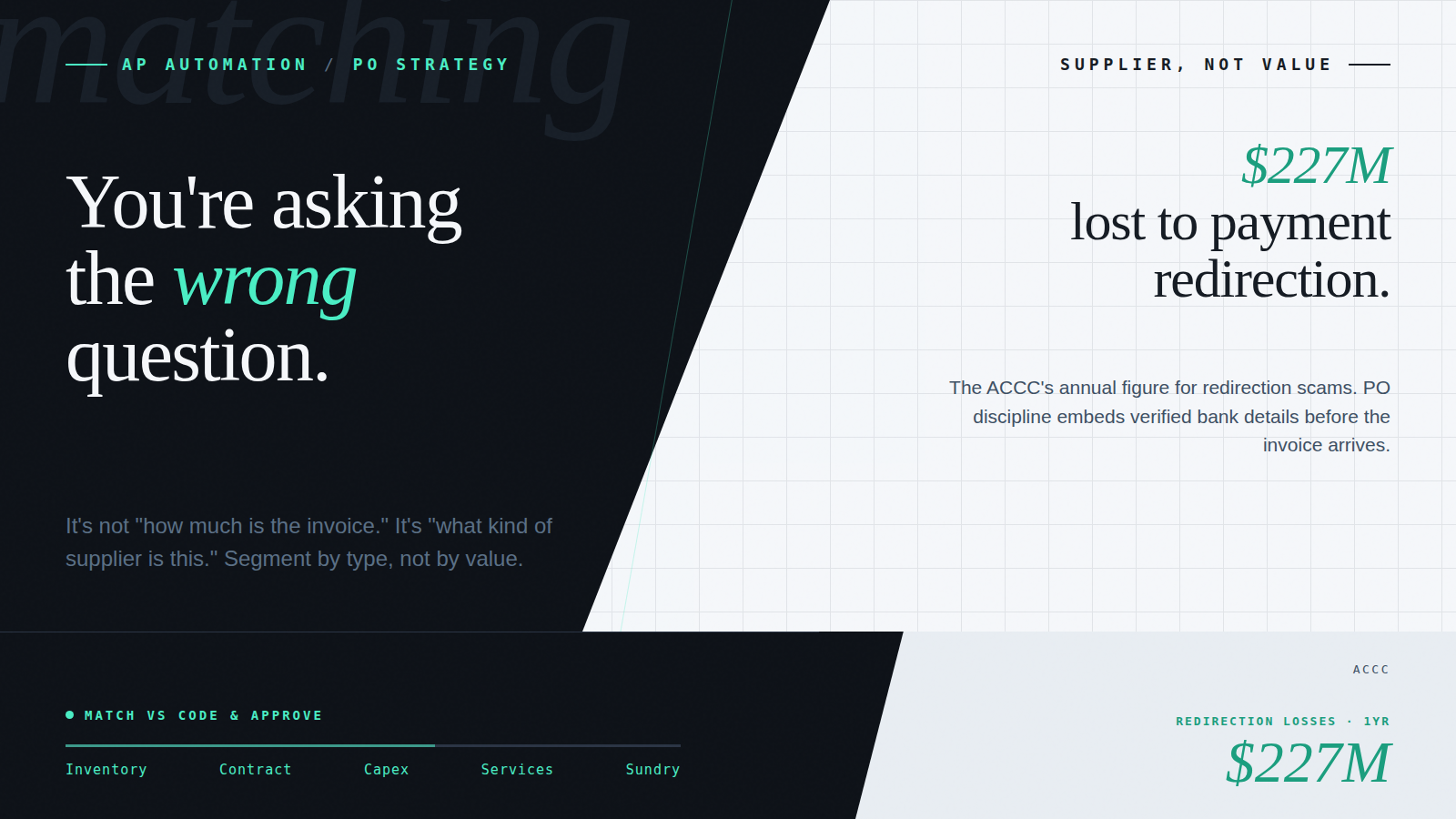
Payment redirection scams remain a significant risk for Australian businesses. The ACCC (Australian Competition and Consumer Commission) has reported losses of $227 million in a single year from these schemes alone. PO-based workflows reduce exposure by embedding verified supplier bank details and approval structures into the commitment process before the invoice arrives, meaning a fraudulent bank detail change has to bypass both the PO approval and the invoice matching step.
Cashflow Visibility
Open POs provide immediate, structured visibility into future cash commitments. For financial controllers managing working capital, the difference between “approved POs outstanding” and “invoices not yet received” is the difference between planning and guessing. PO discipline turns AP from a reactive recording function into a forward-looking financial control.
When Code and Approve Is the Right Answer
PO-first is not the right answer for every supplier. For variable and sundry spend, post-invoice code and approve is genuinely more appropriate, not a compromise, but the correct tool for the job.
- Variable professional services. Legal fees, consulting engagements, and advisory work where the final scope and cost aren’t known in advance. A PO for an open-ended legal matter is an estimate, not a commitment.
- Emergency repairs. When a piece of equipment fails at 11pm, the right response is to authorise the repair, not raise a PO. Post-invoice approval with a clear exception code handles this cleanly.
- Employee expense claims and corporate cards. Transactions already completed by employees. The approval happens retrospectively by design.
- Truly one-off sundry purchases. Ad hoc spend where the administrative overhead of a PO outweighs any control benefit it provides.
The key discipline here is keeping these categories genuinely contained. Code and approve works for variable spend. It breaks down when inventory and contracted service spend migrates into it because the value threshold is below the PO trigger.
The Middle Categories: Capex and Contracted Services
Capex and Project Suppliers
Infrastructure, software, and construction suppliers typically involve variable, milestone-driven spend where the final cost isn’t fixed at commitment. A hybrid model works well: an initial PO captures the approved budget and commitment, with a defined change-order approval threshold for variations. The PO establishes control without requiring certainty upfront.
Contracted Services
Cleaning, maintenance, and retainer-based services are regular and budgeted, but processing a separate approval each time the monthly cleaning invoice arrives is unnecessary overhead. Blanket or recurring POs handle this efficiently: a single approved PO covers a defined period or volume, and invoices are matched against it automatically as they arrive.
Implementing Supplier Segmentation: A Practical Sequence
Shifting from a value-threshold model to a supplier-segmented model is a policy change as much as a system change. In our experience with ANZ clients, the sequence that works is:
- Vendor master review. Segment active suppliers by purchase nature: inventory, capex, contracted services, variable/sundry. Most businesses find that 60–70% of their invoice volume by count comes from a relatively small number of inventory and contracted service suppliers, exactly the categories that benefit most from PO discipline.
- Policy formulation. Define clear rules for each category. Inventory vendors: mandatory PO regardless of transaction value. Services vendors: flexible approach based on transaction complexity and frequency. Document the exception-handling process before the system goes live.
- System configuration. AP automation platforms like Acume enforce supplier-specific policies automatically, flagging invoices that arrive without a required PO before they enter the approval workflow, rather than after. This prevents policy bypass without requiring manual policing.
- Training and communication. The most common point of failure isn’t system configuration, it’s the purchasing team not understanding why the policy exists. The “POs slow things down” objection disappears quickly when people understand that the alternative is a stocktaking variance that takes three times longer to fix than the PO would have taken to raise.
- Ongoing monitoring. Track unmatched invoices, exception rates by supplier category, and PO coverage rates. These metrics tell you where the policy is working and where it’s being circumvented. Review quarterly and adjust.
Addressing the Common Objections
Three objections come up consistently when finance teams move toward supplier-segmented PO policies:
“POs slow transactions down”
Modern AP automation platforms process PO approvals significantly faster than the manual coding, chasing, and exception-handling that follows a mismatched invoice. The delay isn’t in the PO, it’s in the discrepancy that the PO would have prevented.
“Low-value invoices don’t need POs”
For inventory suppliers, they do. A $50 invoice for stock items processed without a PO creates an inventory record gap. Fixing that gap, identifying the discrepancy, tracing it back to the delivery, correcting the stock level, costs significantly more than the $50 invoice. The value of the transaction is irrelevant; the nature of the purchase is everything.
“Suppliers won’t reference PO numbers”
Supplier compliance improves substantially when PO numbers are embedded in the purchasing communication rather than requested retrospectively on the invoice. When the PO is issued digitally, and the supplier is notified at the point of commitment, referencing the PO number on the invoice becomes the path of least resistance.
The eInvoicing Connection: Why PO Discipline Matters for 2026
There’s a forward-looking reason to get supplier segmentation right now: eInvoicing.
Australia’s eInvoicing mandate, built on the Peppol network, is expanding toward 2026 compliance deadlines. eInvoicing replaces PDF invoices with structured, machine-readable data exchanged directly between accounting systems. For three-way matching, this is significant: structured eInvoice data eliminates the OCR and capture errors that currently reduce matching accuracy in PDF-based workflows, enabling cleaner, faster straight-through processing.
But eInvoicing only delivers that benefit if the PO framework it’s matching against is clean and consistent. Businesses that build supplier-segmented PO discipline now are building the foundation that makes Peppol-based eInvoicing work well in 2026. Businesses that don’t will find that eInvoicing surfaces their PO coverage gaps faster than PDF processing ever did.
Acume supports both PDF and eInvoice formats natively, so clients can begin benefiting from structured matching now while building toward full Peppol compliance ahead of the mandate.
What Good Looks Like
Organisations that implement a supplier-segmented PO approach consistently see measurable improvements. The ATO benchmarks paper invoice processing at approximately $30 per invoice and PDF invoicing at approximately $27, and Ardent Partners’ research links high PO-invoice matching rates directly to improved straight-through processing. Across a business processing hundreds of invoices per month, the combined cost reduction from clean PO data and structured matching is material.
The specific outcomes:
- Higher straight-through processing rates. Clean PO data means more invoices match automatically and fewer require manual intervention.
- Reduced exception volume. Price and quantity discrepancies are caught at matching, not discovered during reconciliation. The cost of resolution drops significantly when exceptions are caught early.
- Accurate inventory records. Stock levels reflect actual movements. Reorder points are reliable. Stocktaking variances shrink.
Conclusion: Segment by Supplier, Not by Value
Value thresholds feel like a practical solution to the PO overhead problem. In reality, they create gaps in exactly the places where control matters most, inventory accuracy, contract compliance, and fraud prevention.
The supplier-segmented approach requires more upfront thinking: reviewing the vendor master, defining category-specific policies, configuring systems to enforce them. But it pays back quickly. Inventory suppliers always need a PO. Variable services almost never do. Everything else sits somewhere in between, and the right framework makes that easy to configure and enforce.
The question isn’t whether your value threshold is set at the right level. It’s whether you’re using the right variable.
Ready to Configure Supplier-Specific AP Policies?
Acume works with ANZ mid-market businesses running Xero or MYOB to implement AP automation that reflects how their supplier base actually works, with supplier-specific PO policies enforced automatically, and both PDF and Peppol eInvoice formats handled natively.
Contact us to talk through your supplier segmentation and PO matching setup with our team.
Frequently Asked Questions
What is supplier segmentation in accounts payable?
Supplier segmentation in AP is the practice of classifying your supplier base by purchase type; inventory, contracted services, capex, or variable spend, and applying different AP controls to each category. For inventory and resale goods suppliers, PO-based matching is always required regardless of invoice value. For variable professional services, post-invoice code and approve is the correct approach. The segmentation replaces value-threshold PO rules with controls that reflect the actual nature and risk of each supplier relationship.
What is three-way matching in accounts payable?
Three-way matching is the process of automatically comparing a purchase order, a goods receipt, and a supplier invoice to confirm all three align before payment is approved. When inputs are clean and structured, it enables straight-through processing for the majority of matched invoice volume with no human touch. Discrepancies, price differences, quantity variances, missing receipts. are flagged for review rather than passing silently through to payment.
When should you use PO matching vs code and approve?
The decision should be based on supplier type, not invoice value. Inventory and resale goods suppliers should always use PO-based matching regardless of invoice amount. Variable and ad hoc service suppliers are generally better suited to post-invoice code and approval. Contracted services and capex suppliers typically benefit from blanket or hybrid PO models. The key is that the decision is made at the supplier level, not the transaction level.
Why is a value threshold the wrong approach to PO decisions?
A value threshold misses the reason PO controls exist. For inventory suppliers, even low-value invoices have a significant impact on stock accuracy, a $50 invoice processed without a PO creates a stocktaking variance that is expensive to trace and correct. The nature of the purchase, not the amount, determines whether a PO is necessary. Value thresholds create control gaps in exactly the supplier categories where the consequences of missing a PO are highest.
How does eInvoicing improve PO matching accuracy?
eInvoicing replaces PDF invoices with structured, machine-readable data exchanged directly between accounting systems via the Peppol network. This eliminates the OCR and capture errors that currently reduce matching accuracy in PDF-based workflows. When PO, goods receipt, and invoice data are all structured and machine-readable, three-way matching runs faster, generates fewer exceptions, and delivers higher straight-through processing rates, but only if the underlying PO framework is already clean and consistently applied.
A demo on your actual workflow.
A live walkthrough using real data – the capture, the coding, the approval routing – and how it sits inside the AP workflow you already run. No slideware.