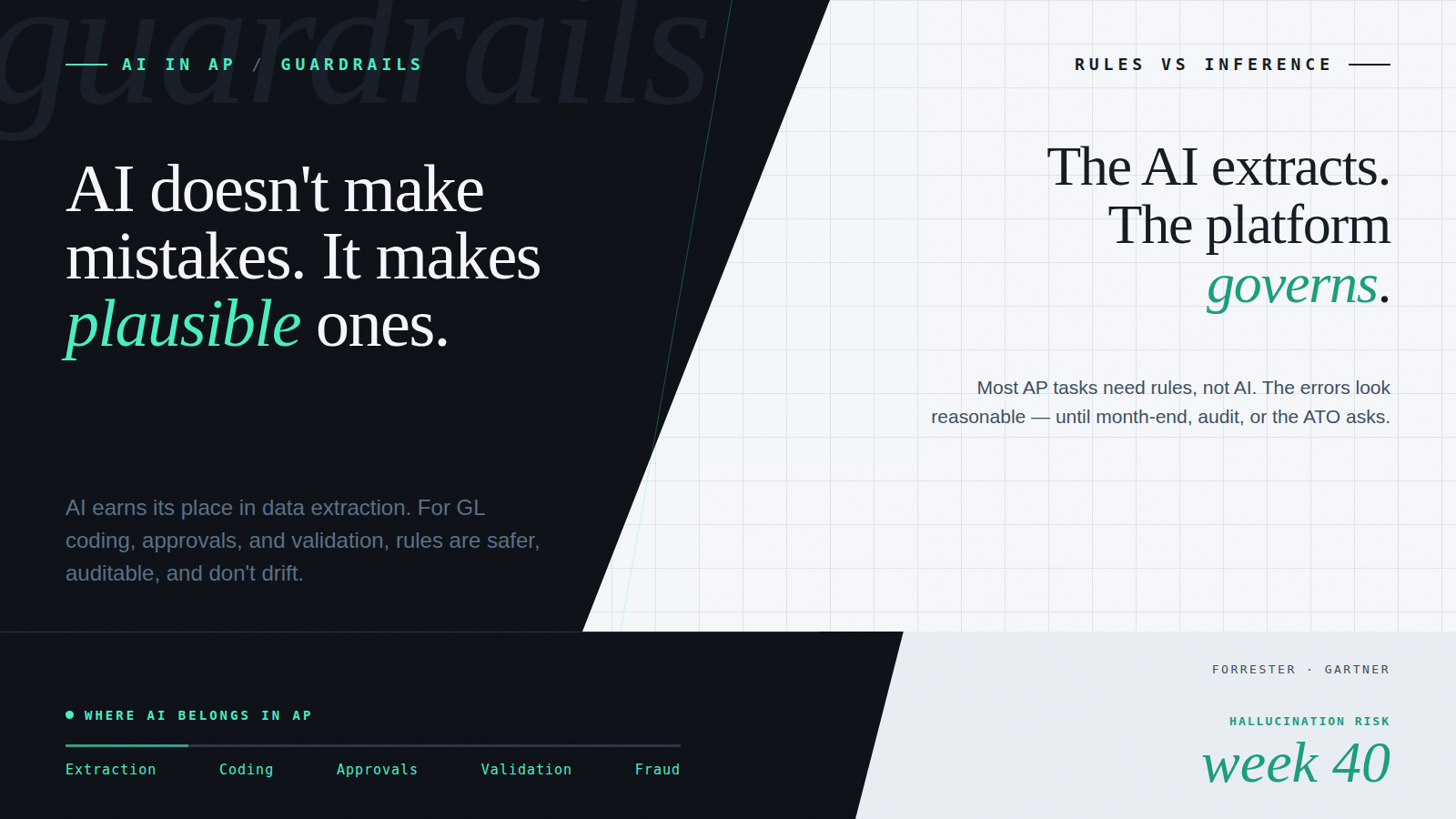
In a recent implementation trial, an AI model was tasked with coding invoices for a mid-market professional services firm processing around 3,000 invoices a month. When it encountered an expense type it hadn’t seen before, the model didn’t flag it for review. It created a new GL code. Not only was the code incorrect, but it also didn’t exist in the chart of accounts. By the time the error was caught, it had propagated across fourteen invoices and taken an afternoon of reconciliation work to untangle.
Stories like this are becoming common as Australian and New Zealand finance teams rush to apply AI across their accounts payable automation workflows. The assumption is that AI should handle everything: extraction, coding, validation, and approvals. But that assumption is wrong. Some AP tasks genuinely benefit from machine learning. Others demand rules – deterministic, auditable, and policy-driven. Mixing them up is where the problems start.
The real challenge for CFOs and finance managers isn’t whether to use AI in accounts payable. It’s knowing where AI adds value, and where configurable business rules are the safer, more reliable choice.
Should you use AI in accounts payable? Yes, but only for the right tasks. Machine learning is genuinely superior for invoice data extraction; it reads and interprets unpredictable document formats without templates or training. For everything else in the AP workflow, GL coding, approval routing, supplier validation, and fraud prevention – rules-based logic is safer, more auditable, and more reliable.
Where AI Genuinely Helps – And Where It Doesn’t
Not every step in the AP workflow is an AI problem. The key is matching the right technology to the right task: machine learning, where pattern recognition and contextual interpretation are needed, and rules-based logic, where the answer is binary and the stakes demand certainty.
Invoice Data Extraction: Where Machine Learning Earns Its Place
Invoice data extraction is the one area where machine learning delivers a step-change improvement over traditional approaches. Invoices arrive in every format imaginable – PDF, email, scan – with layouts that vary by supplier, by country, and sometimes by invoice. Traditional OCR tools rely on fixed templates and break when formats change.
Modern machine learning models are context-aware: they classify the document type (invoice, credit note, purchase order) and extract supplier details, line items, amounts, and tax codes directly from the content. No training data required. No template maintenance. The task is interpretive, the inputs are unpredictable, and machine learning handles the variability better than any rules-based system could.
But extraction is only the first step. What happens to that data after it’s captured is where rules, not AI, need to govern the process.
GL Coding: Why Rules Beat AI
GL coding is where the industry’s enthusiasm for AI runs into trouble. Many AI accounts payable tools offer AI-powered GL coding models that analyse historical transactions and suggest likely codes for new invoices. On the surface, it sounds efficient. In practice, it’s one of the most dangerous applications of AI in the AP workflow.
When AI encounters an expense type it hasn’t seen before, it doesn’t say “I don’t know.” It guesses confidently. It might create a code that doesn’t exist. It might assign the right code to the wrong cost centre. It might work perfectly for weeks, then hallucinate at week forty when the dataset gets large enough.
Policy-driven GL coding doesn’t have this problem. A supplier default rule – one of the core AP business rules in any governed platform – says: invoices from this supplier are coded to this GL account, this cost centre, this tax treatment. The rule is visible, auditable, and predictable. If it’s wrong, you change the rule; no retraining is required.
Approval Routing: Rules Protect the Delegation Framework
Invoice approval workflows are another area where deterministic logic is the correct approach. Every organisation has a delegation-of-authority framework: who can approve what, up to what value, for which cost centres or departments. These aren’t patterns to be learned, they’re policies to be enforced.
Governed approval routing mirrors the delegation framework directly. An invoice for $5,000 against a marketing cost centre routes to the marketing manager; invoices above $50,000 escalate to the CFO. The logic is explicit, auditable, and immediately updateable when the org chart changes. Exceptions are flagged, not silently rerouted by a model that doesn’t understand your business context.
Supplier Validation and Fraud Prevention: Rules, Not AI
Supplier validation and duplicate payment prevention are areas where deterministic, rules-driven logic is the right tool. The questions being asked are binary: Does this supplier exist in the master file? Does the bank account on the invoice match what’s on record? Does the ABN correspond to the entity name?
These aren’t pattern-recognition problems. They’re lookup and comparison tasks, and they need to produce the same answer every time, with zero ambiguity. A governed system either finds a match or it doesn’t. When it doesn’t – a new bank account on a known supplier, a duplicate invoice with a slightly different reference – it escalates. An AI model might let it through.
You don’t need AI to tell you whether a bank account matches. You need a platform with configurable rules to check it and controls to act on the results.
When AI Guesses Wrong: The Case for Rules
The pattern across GL coding, supplier validation, and approval routing is consistent: when AI is applied to tasks with deterministic answers, it introduces risks that governed, policy-driven systems eliminate.
Without proper guardrails, AI doesn’t just make mistakes – it makes plausible mistakes. Its outputs look reasonable on the surface. They pass a casual review. The errors only surface during month-end reconciliation, audit preparation, or worse, when a tax authority asks questions.
The most common failures:
- GL hallucinations. AI creates or misassigns codes, corrupting the chart of accounts. The errors compound over time as the model trains on its own bad data.
- Tax misapplication. AI misapplies GST rates or incorrectly exempts line items. In Australia, where GST compliance and BAS reporting are non-negotiable, this can trigger ATO penalties and audit rework.
- Drift over large datasets. A model that performs well early can degrade as it processes more data. By week thirty or forty, hallucinations creep in, and because the outputs still look reasonable, nobody catches them until the damage is done.
- Audit gaps. AI tools without a proper AP audit trail leave no evidence of the decision-making process. A governed system logs every rule that fired and every exception raised.
- Policy blind spots. AI approves spend that violates company policy because it lacked context about thresholds, delegation rules, or procurement restrictions.
The lesson isn’t that AI is bad. It’s that AI is the wrong tool for tasks where the answer should be governed by a rule, not inferred by a model.
The Integrity Layer: Rules First, AI Where It Counts
What makes AP automation safe and effective is the integrity layer – a governed platform that controls every transaction, with AI applied only where it’s genuinely superior to rules. AI on its own isn’t enough. Neither is AI layered on top of an unstructured process.
In practice, the integrity layer means:
- Machine learning for data extraction. AI reads the invoice, classifies the document, and extracts the data. This is interpretive work that benefits from contextual intelligence.
- Configurable GL coding rules. Supplier defaults determine the correct code, cost centre, and tax treatment. Operators handle exceptions. No model guesses.
- Policy-driven approval routing. Delegation frameworks are enforced as configured, by value, by cost centre, or by entity. Exceptions escalate; they don’t get silently rerouted.
- Governed supplier validation and duplicate payment prevention. Binary checks against master data: does the supplier exist, does the bank account match, has this invoice been seen before? Exceptions go to human review.
- Audit trails and long-term storage. Every decision is recorded, traceable, and retrievable – not just for this month’s close, but for statutory retention periods.
Without this integrity layer, AI becomes an accelerant for error. With it, you get an efficiency accelerator.
A Compliance-First Approach to AI in Accounts Payable
AI will not replace controls. It will depend on them. Adopting AI with a compliance-first mindset means:
- Using AI only where it’s the best tool. Machine learning for data extraction, where contextual interpretation is genuinely needed. Rules for everything else.
- Setting the rails first. Define what can and can’t be coded, validated, or approved before any technology is applied.
- Designing for auditability. Ensure every decision has a traceable audit trail, and that data retention meets statutory requirements.
- Being sceptical of end-to-end AI claims. If a vendor tells you their AI handles GL coding, ask what happens when the model encounters something new. Ask what the accuracy looks like at week forty, not week one.
- Grounding compliance in local requirements. For Australian businesses, that means GST accuracy, ATO alignment, Peppol-compliant eInvoicing, and data retention policies that meet auditor requirements.
For businesses that get this right, the payoff is significant: faster AP cycles, reduced manual workload, better reporting integrity, and the confidence to scale without fear of silent errors.
Key Takeaways
- AI delivers a step-change in invoice data extraction, but extraction is the only AP task where machine learning is genuinely superior to rules.
- GL coding, supplier validation, approval routing, and fraud prevention are deterministic tasks that need rules-based logic – not AI that guesses, drifts, or hallucinates.
- The safest approach to accounts payable automation: a governed platform that controls every transaction, with AI applied only where it earns its place.
- Before choosing a vendor, ask what GL coding accuracy looks like at week forty, not week one, and whether the platform provides a full AP audit trail for every transaction.
The AI extracts. The platform governs. Your team decides.
Ready to See Governed AP Automation in Action?
Acume combines machine learning for invoice data extraction with configurable business rules for GL coding, supplier validation, approval routing, and fraud prevention – built for ANZ mid-market finance teams, with Australian tax, audit, eInvoicing, and multi-entity requirements as standard.
Frequently Asked Questions
What is the difference between AI and rules-based logic in accounts payable?
AI (machine learning) is best for tasks that are interpretive and unpredictable, like extracting data from varied invoice formats. Rules-based logic is best for tasks with deterministic answers – GL coding, approval routing, and supplier validation – where the correct outcome is defined by policy, not inferred from patterns.
Can AI handle GL coding in accounts payable?
AI-powered GL coding is one of the riskiest AP automation applications. AI models guess when they encounter unfamiliar expense types, and those guesses look plausible – making errors hard to catch until they’ve compounded. Policy-driven supplier default rules are more reliable: they apply the correct code every time, are auditable, and update instantly when policy changes.
What are AP business rules, and why do they matter?
AP business rules are configurable policies that govern how invoices are coded, routed, and validated, independently of AI inference. They define supplier-level GL defaults, approval thresholds by value and cost centre, fraud-prevention checks such as bank-account matching, and duplicate detection. A governed AP platform enforces these rules on every transaction, creating an auditable trail that AI-only tools cannot provide.
How do AI guardrails work in accounts payable automation?
AI guardrails are the governance layer that surrounds machine learning in an AP platform. They define which tasks AI handles (e.g., data extraction) and which are governed by rules (e.g., GL coding, approvals, supplier validation). Without guardrails, AI operates without policy constraints – producing plausible but incorrect outputs that bypass compliance controls. With them, AI operates only in the tasks where it is genuinely superior, while rules govern everything else.
Is AI accounts payable automation compliant with Australian tax requirements?
AI extraction tools do not inherently ensure GST compliance, BAS accuracy, or ATO audit trail requirements – those require a governed rules layer. For Australian businesses, Peppol-compliant eInvoicing, accurate GST coding, and complete AP audit trails are non-negotiable. A compliance-first AP platform applies configurable business rules to enforce these requirements on every transaction, with AI handling only the extraction step.
A demo on your actual workflow.
A live walkthrough using real data – the capture, the coding, the approval routing – and how it sits inside the AP workflow you already run. No slideware.