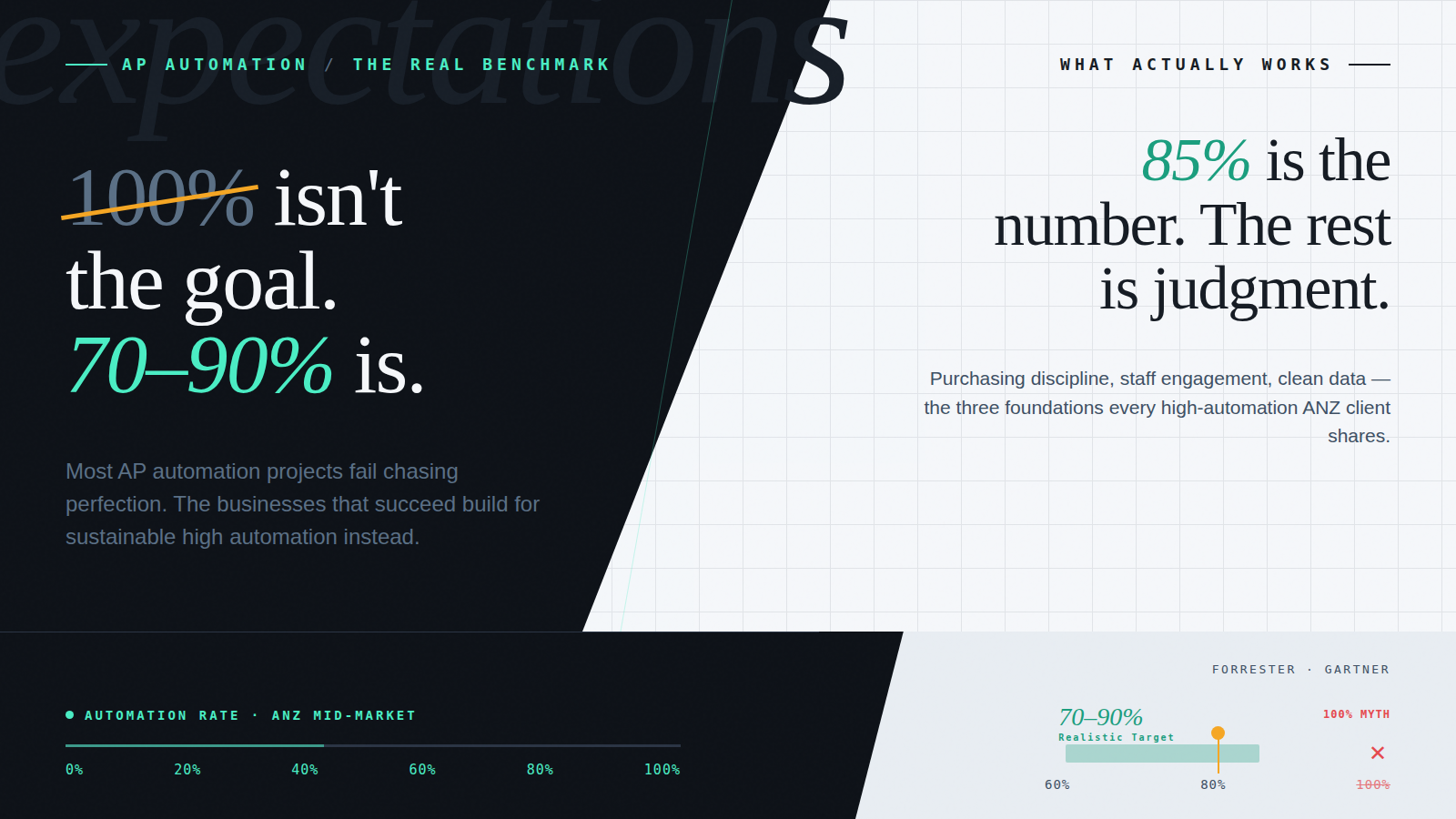
Most AP Automation Projects Fail – But Not Because of the Technology
Most AP automation projects don’t fail because the technology is broken. They fail because organisations chase the wrong target. The promise of “100% automation”, invoices flowing from supplier to payment without a single human touch, has become a kind of holy grail for finance leaders under pressure to deliver transformation quickly. And it’s the wrong goal.
The reality? For most ANZ businesses, 70–90% automation is both achievable and sustainable, and that level of efficiency is enough to fundamentally transform AP from a cost centre into a strategic enabler. Chasing the last 10–30% often costs more than it’s worth.
Industry analysts back this up. Forrester’s 2025 analysis of AI in accounts payable shows that adoption is mature in areas such as invoice data capture and matching, but still lags in fraud detection, compliance, and reporting. Some processes are ripe for near-touchless automation; others remain stubbornly dependent on human judgment, and that’s not a technology failure; it’s the nature of the work.
Think of automation as the amplifier, not the instrument. Without a well-tuned foundation, it will simply make the noise louder.
The Allure of 100% Automation
Finance leaders are under pressure to do more with less: shrinking budgets, growing compliance demands, and a relentless drive for efficiency. Against that backdrop, the promise of “zero-touch” AP automation sounds irresistible.
It’s easy to see why:
- Cost savings: Eliminate manual entry, approvals, and corrections.
- Speed: Invoices move instantly from receipt to payment.
- Control: Fewer errors and stronger compliance.
But analysts caution against taking the 100% promise at face value. The 2025 Gartner Magic Quadrant for Accounts Payable Applications notes that while some vendors excel in predictive coding and anomaly detection, no single solution delivers perfect end-to-end automation across all invoice types and business structures.
The danger is that organisations assume the technology alone will deliver outcomes, while ignoring the messy reality of purchasing behaviour, data discipline, and exceptions. When those foundations are weak, the result isn’t perfection; it’s frustration.
What High Automation Actually Looks Like
For most ANZ mid-market businesses, 70–90% automation is a realistic and sustainable target, not a consolation prize. Benchmarks support this, especially in PO-driven environments. At Acume, we work with ANZ businesses typically running 10 to 40 staff on Xero or MYOB or more on mid to enterprise ERP’s and the clients who achieve the highest automation rates share three characteristics:
- Purchasing discipline. Invoices consistently reference valid purchase orders, enabling accurate three-way matching between PO, receipt, and invoice. Without this, even the best automation software struggles.
- Staff engagement. Employees understand the “why” of the process and follow it. Automation amplifies good behaviour, but it also magnifies bad habits.
- Clean data. Supplier master data, PO formats, and coding standards are well-maintained. Garbage in, garbage out is still the fundamental rule of AP automation.
Forrester’s adoption research confirms this: companies with strong process foundations achieve materially higher automation success rates than those relying solely on technology. At Acume, we’ve seen clients reach around 85% automation for PO-to-invoice transactions when these foundations are in place.
Where the Technology Delivers
Technology has advanced significantly, and AP teams today have access to powerful automation capabilities that were out of reach for mid-market businesses even five years ago:
- Default coding: Recurring expenses, such as rent, utilities, and subscriptions, can be auto-coded reliably.
- Three-way matching: Where purchase orders, receipts, and invoices align, automation can close the loop without human intervention.
Gartner’s Market Guide for AP Invoice Automation notes that ML parsing of machine-readable documents can deliver accuracy rates in the high 90% range, provided the data inputs are clean and structured. This is where automation works beautifully, and for many organisations, it covers 70–90% of total invoice volume.
The Limits of Today’s Automation
100% touchless AP automation is still out of reach for most businesses, and for some, it may remain so. The common failure points are predictable:
- Non-PO invoices. Ad hoc spending and services that bypass purchase orders are notoriously harder to automate.
- Complex spend categories. Professional services, construction, and one-off purchases often require human interpretation or approvals.
- Supplier data issues. Missing information, inconsistent formats, or incorrect coding can derail even well-configured automation.
- Compliance and regulatory requirements. Fraud detection, anomaly handling, and, increasingly, eInvoicing compliance still require significant human oversight, according to Forrester’s 2025 report.
That last point is becoming more urgent for ANZ businesses. Australia’s eInvoicing mandate, built on the Peppol network, is expanding, with 2026 compliance deadlines now in scope for government suppliers and, progressively, for broader business-to-business transactions. eInvoicing replaces PDF invoices with structured data exchanged directly between accounting systems, reducing processing costs from ~$27 per PDF invoice to under $10 per eInvoice (ATO benchmarks).
Acume supports both PDF and eInvoice formats natively, which means clients don’t have to choose between eInvoicing compliance and their existing AP automation workflows. But the broader point is this: organisations that haven’t started thinking about eInvoicing readiness are adding to their exception load, not reducing it.
Building the Right Foundations
If 100% automation isn’t the goal, what should finance leaders aim for? The answer: build the right foundations, then let technology scale them. Based on what we see with ANZ clients, the organisations that sustain high automation rates invest in three areas:
- Process alignment. Consistent PO usage, standardised approval workflows, and clear coding rules are the bedrock. No software will fix a chaotic purchasing process; it will just make the chaos faster.
- People investment. Training staff and building a culture of process discipline pays dividends at every automation level. The technology serves the people who use it, not the other way around.
- Data discipline. Clean vendor master data, structured POs, and accurate coding standards ensure automation tools have reliable inputs. This includes getting supplier onboarding right, a step many organisations underinvest in.
Ramp’s research lists data quality, integration complexity, and internal resistance as the most common causes of AP automation failure. Technology alone won’t fix these gaps. The organisations that get to 80–90% automation and stay there are the ones that treat process and data as ongoing disciplines, not one-time implementation tasks.
Conclusion: Chasing the Right Goal
The pursuit of 100% AP automation can be seductive. But the smarter goal is to build the right combination of people, process, and technology to achieve high automation where it matters most, and to layer compliance readiness on top of that.
Gartner, Forrester, and other analysts all make the same point: automation outcomes are uneven, maturity varies by process, and the biggest gains come when technology is built on strong process and data foundations. The eInvoicing shift now underway in Australia adds a new dimension to that equation, one that will separate the businesses that are ready from those that are not.
At Acume, we’ve seen that when ANZ businesses focus on these foundations, and pair them with a platform that handles both PDF and eInvoice natively, integrates with Xero and MYOB, and other ERPs, supporting compliance requirements, coming in 2026 80–90% automation is achievable and sustainable. That’s the goal worth building toward.
The question for finance leaders isn’t: “How do we get to 100%?”
It’s: “Are we building the right kind of automation success?”
Ready to Build the Right Foundations?
Acume works with ANZ mid-market businesses to implement AP automation that delivers measurable, sustainable results. Whether you’re just starting out or looking to push past a plateau, we’d love to help you assess where you are and what’s possible.
Contact us to talk through your AP automation goals with our team.
Frequently Asked Questions
What is AP automation and what does it actually do?
AP automation (accounts payable automation) replaces manual invoice processing tasks — data entry, GL coding, approval routing, and ERP posting – with software-driven workflows. For ANZ mid-market businesses, it typically covers invoice capture, three-way PO matching, configurable approval workflows, supplier validation, and integration with Xero or MYOB, reducing processing cost from ~$27 per PDF invoice to under $10 with eInvoicing.
What is a realistic AP automation rate for most businesses?
For most mid-market businesses with structured PO processes and clean data, 70–90% invoice automation is a realistic and sustainable target. Reaching 100% is rarely achievable and often not worth the investment required to get there.
Why can’t AP automation reach 100%?
Exceptions will always exist — non-PO invoices, complex spend categories, supplier data issues, and compliance requirements all require human judgment. Fraud detection and anomaly handling in particular remain areas where human oversight adds essential value.
What ROI can I expect from AP automation?
A Forrester TEI study on a mature AP automation deployment found 158% ROI over three years, including approximately 50% productivity gains for AP staff and significant working capital improvements. These results are achievable at 70–90% automation – you don’t need 100% to realise the full business case.
How does eInvoicing affect AP automation in Australia?
Australia’s eInvoicing mandate, built on the Peppol network, is expanding toward 2026 compliance deadlines. eInvoicing replaces PDF invoices with structured data exchanged directly between accounting systems, reducing processing cost from ~$27 per PDF invoice to under $10. Organisations that build dual-format AP workflows now – handling both PDFs and Peppol eInvoices – are ahead of the mandate rather than scrambling to retrofit compliance.
A demo on your actual workflow.
A live walkthrough using real data – the capture, the coding, the approval routing – and how it sits inside the AP workflow you already run. No slideware.