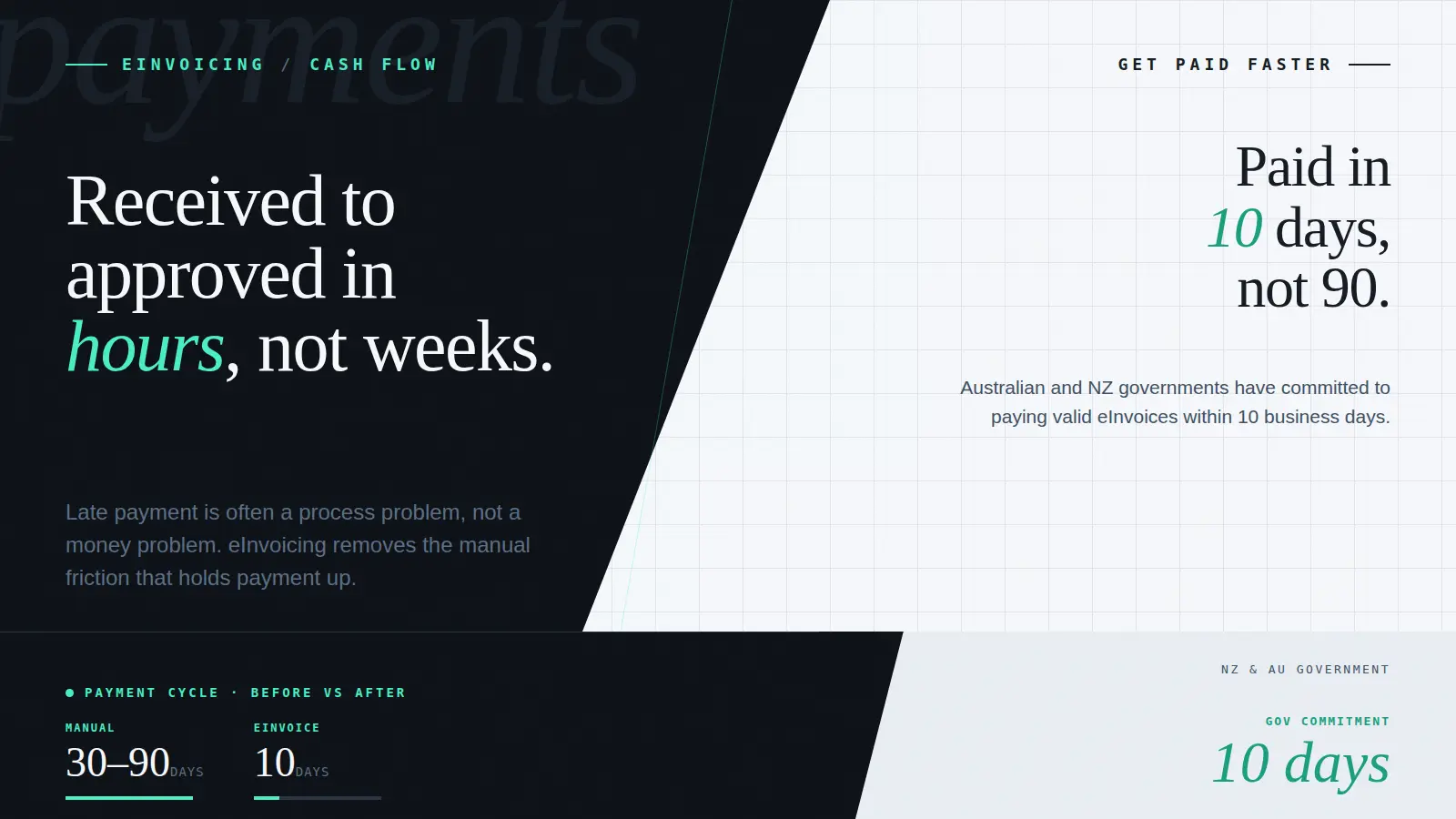
Who doesn’t want to get paid faster?
Late payments are a challenge for many businesses, and they usually come down to two core reasons.
The first is financial: the customer simply doesn’t have the cash. That’s a tough problem to solve, and eInvoicing won’t change that.
The second, though, is process-related. It’s about how long it takes a business to capture, review, approve, and queue an invoice for payment. And that’s where eInvoicing makes a big impact.
Unlike traditional methods, eInvoicing doesn’t rely on emailed PDFs or manual data entry. Instead, invoice data is sent directly from the supplier’s system to the customer’s accounting software via the Peppol network. That means no scanning, no retyping, and no chasing people for approvals.
The result?
Invoices move faster through the system—often going from received to approved in a matter of hours, not weeks.
Governments in New Zealand and Australia have recognised this advantage. Both have committed to paying valid eInvoices within 10 business days—a major shift from the 30 to 90-day cycles most suppliers are used to.
When you remove the friction of manual workflows, payments move faster. That means better cash flow for suppliers and more efficient operations for buyers.
Want to speed up your invoice payments?
Talk to Acume about how to implement eInvoicing in your AP/AR workflow—fast, secure, and ready to scale.
Where to Go Next
- Accounts receivable automation with Acume – the AR solution page, for getting paid faster.
- Central billing for dealer networks and national accounts – outbound eInvoicing at scale.
- eInvoicing with Acume – the solution page, including Peppol access.
A demo on your actual workflow.
A live walkthrough using real data – the capture, the coding, the approval routing – and how it sits inside the AP workflow you already run. No slideware.