The quarterly VAN invoice arrives the same way it always does.
Your IT team processes it without much scrutiny, it’s one of those recurring costs that’s been in the budget for so long, it’s stopped being a line item anyone questions. But this quarter, the total is higher again. Not because the supplier count changed. Because order volumes are up, the VAN charges per transaction are up.
You’ve heard eInvoicing mentioned more frequently lately, the ATO mandate, Peppol, and the 2026 deadlines. You’ve been meaning to understand whether it’s relevant to your business or just noise for smaller companies. You’ve also been wondering whether eInvoicing is basically the same thing as EDI with a different name.
It isn’t. The two technologies solve the same fundamental problem, structured electronic document exchange between trading partners, but they’re architecturally different, price very differently, and suit different scales and contexts. If you’re currently running EDI via a VAN, or evaluating whether to start, this comparison is the one to read before your next renewal conversation.
What EDI via VAN Actually Is – and Why It Was the Right Answer for Decades
Electronic Data Interchange pre-dates the Internet. It emerged in the 1970s and 1980s as a way for large organisations to exchange structured business documents, such as purchase orders, invoices, and advance ship notices, without paper. By the 1990s, it had become the standard for high-volume supply chains in retail, automotive, logistics, and healthcare.
The architecture is hub-and-spoke. A Value-Added Network sits in the middle. Trading partners connect to the VAN, and the VAN handles translation, routing, and guaranteed delivery between them. If a retailer uses SAP and a supplier uses JDE, the VAN translates between their respective EDI formats, allowing both sides to exchange structured data without building a direct integration.
This solved a genuine problem. Before VANs, getting two large organisations with different ERP systems to exchange machine-readable documents reliably required bilateral agreements, custom software, and ongoing maintenance for each trading relationship. A VAN centralised that complexity. You connected once and gained access to a managed network.
The cost model followed the architecture. VANs charge per transaction, typically per kilocharacter (a unit of data volume) or per document, plus monthly platform fees. They also charge per trading partner connection: each new supplier or customer relationship requires a bilateral setup involving format mapping, testing, and VAN configuration, typically billed as a project.
For large enterprises processing millions of documents across hundreds of established trading partner connections, this model is justifiable. The cost is significant but the value is clear: reliability, guaranteed delivery, deep ERP integration, and a managed network that handles the complexity of hundreds of different format requirements.
The question is whether that cost model still makes sense for mid-market businesses in 2026, when an alternative architecture exists that doesn’t charge per transaction, doesn’t require bilateral setup per trading partner, and is backed by a government mandate that will expand its adoption regardless.
What Peppol eInvoicing Is – and What Changes Architecturally
Peppol is not just cheaper EDI. It’s a different architecture with different implications.
Where EDI/VAN is a hub-and-spoke model, all connections mediated by the VAN, Peppol is a four-corner network model. Instead of a single intermediary, Peppol is a framework of certified access points that are interoperable with one another. A business connects to one access point; that connection enables them to exchange documents with any other business registered on the Peppol network, anywhere in the world, without a separate setup for each trading relationship.
The analogy is email. When a business sets up an email server, they can exchange messages with anyone else who has an email address, regardless of which email provider either party uses, and without configuring a new connection for each correspondent. Peppol works the same way for structured business documents: one connection, universal reach within the network.
The standards model is also fundamentally different. EDI formats vary by VAN, by industry, and by trading partner; X12 (common in North America), EDIFACT (common in Europe), and countless bespoke XML variants are all in active use. Each trading partner connection potentially requires its own format mapping. Peppol uses a single open standard: PINT A-NZ for Australia and New Zealand, a profile of the global Peppol BIS standard. All Peppol participants use the same format. There is no per-trading partner format mapping within a national jurisdiction.
The cost model follows the architecture, but it’s important to be precise about what that means. Peppol access points charge per transaction, just as VANs do. The critical difference is the order of magnitude: typical ANZ access point fees are approximately $0.05 per send and $0.05 per receive (reducing to around $0.03 with volume), whereas VAN per-document fees can run $0.50 or more. There are no per-connection setup costs, no bilateral trading partner agreements, and no format mapping charges. How that access point cost is presented to end users varies: some AP platforms include it in their per-invoice processing fee, others pass it through separately, and some accounting platforms absorb it into their monthly subscription. In all cases, the per-transaction cost of Peppol access is materially lower than VAN transaction fees at any comparable volume.
EDI via VAN vs Peppol: The Full Comparison
EDI via VAN — Peppol eInvoicing
Architecture — Hub-and-spoke: trading partners connect bilaterally via the VAN as an intermediary. Each trading relationship requires a separate connection. — Network model: any access point connects to any other. No bilateral setup per trading partner – connect once to the network, exchange with anyone registered on it.
Standards — Proprietary or legacy open standards (X12, EDIFACT, bespoke XML). Format varies by VAN and by trading partner – mapping required for each connection. — Open standard: Peppol BIS / PINT A-NZ in Australia and New Zealand. Same format for all participants. No per-partner format mapping.
Onboarding a new supplier — Weeks to months: bilateral trading partner agreement, format mapping, testing, VAN configuration. — Hours to days: supplier registers on the Peppol network; exchange begins when both parties are registered. No additional setup.
Cost model — Per-transaction VAN fees (per kilocharacter or per document) + monthly platform fees + per-connection setup costs. Cost grows linearly with volume. — Per-transaction access point fee (~$0.05 per send, ~$0.05 per receive, reducing to ~$0.03 at volume). No per-connection setup cost. No per-trading-partner bilateral agreement. Access point cost is typically wrapped into the AP platform per-invoice fee or monthly subscription -= it is not free, but is materially lower than VAN per-document fees.
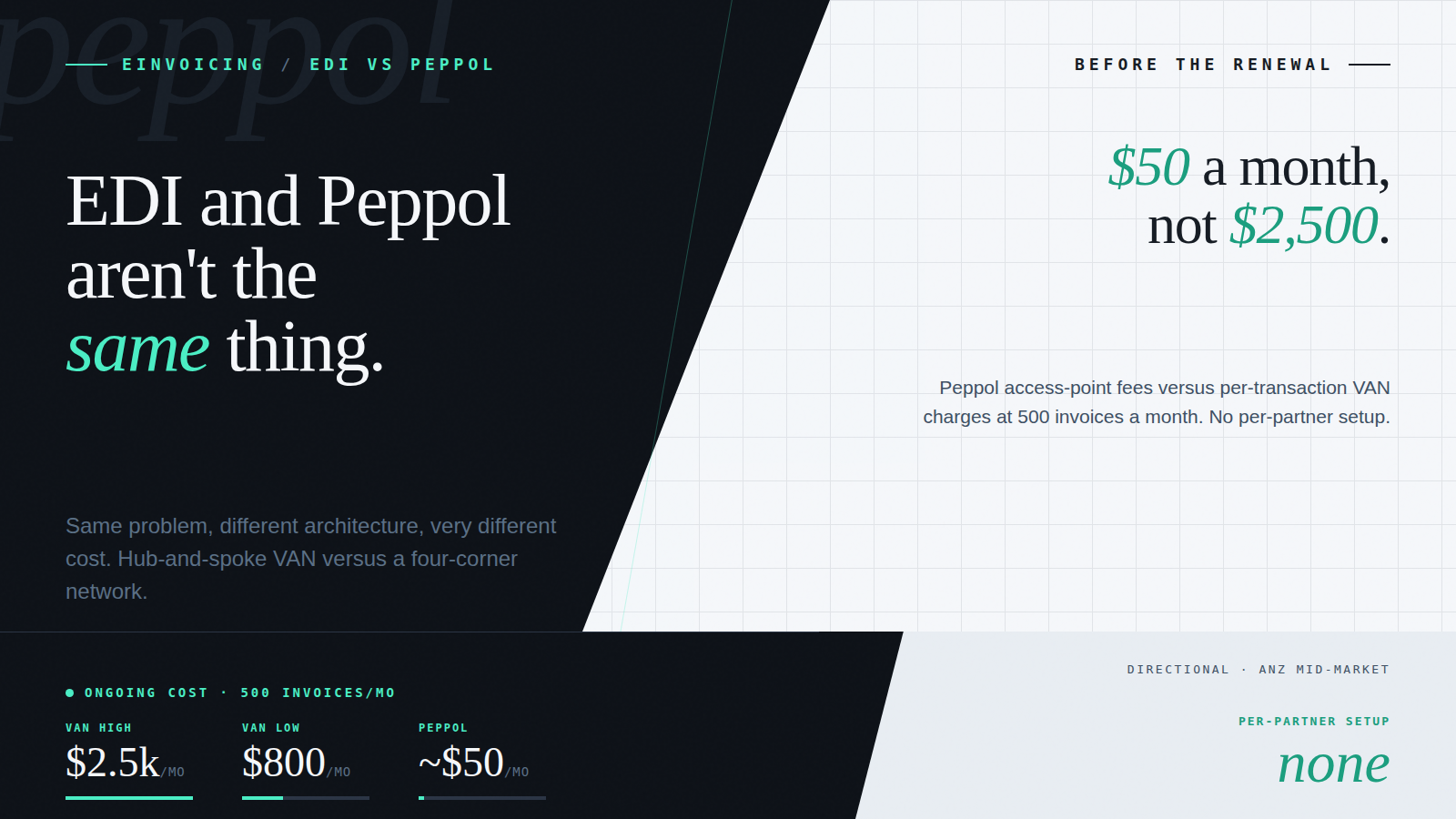
Typical cost (500 invoices/month) — $800–$2,500+/month (VAN fees, platform, maintenance). Varies significantly by provider. — ~$50–$100/month in raw access point fees (send + receive at ~$0.05/transaction). Typically wrapped into AP platform fee. Significantly lower than VAN equivalent.
Typical cost (5,000 invoices/month) — $3,000–$10,000+/month. Per-transaction model becomes expensive at scale. — ~$300–$500/month in raw access point fees at volume pricing (~$0.05/transaction). Cost scales with volume but at a per-transaction rate that is a fraction of VAN fees.
ERP integration — Deep and mature: SAP, Oracle, JDE, and major ERPs have decades of EDI/VAN integration. Reliable at enterprise scale. — Growing: native Peppol support in Xero, MYOB, and most modern ERPs. Middleware available for legacy systems.
ANZ government mandate — Not applicable. — B2G: Commonwealth agencies required to receive Peppol eInvoices (in effect). B2B: voluntary, accelerating toward 2026.
Migration complexity — N/A if staying on EDI. High if migrating existing EDI flows to Peppol – format translation, parallel running, access point setup. — Low for new implementations. Moderate for EDI migration (format translation, parallel running, access point configuration).
Cost ranges are directional for ANZ mid-market businesses and vary significantly by VAN provider, volume, and number of trading partner connections. Request itemised pricing from your current VAN provider as a baseline for comparison. Peppol access point costs vary by provider and volume tier.
What It Actually Costs: Initial and Ongoing
The cost difference between EDI/VAN and Peppol is most pronounced at mid-market volumes, where the per-transaction VAN model is a poor value relative to the delivered value. Understanding the full cost picture requires separating setup costs from ongoing costs.
EDI via VAN – where the costs accumulate
Setup is the first barrier. A full EDI implementation for a mid-market business typically involves a VAN account setup, an ERP integration project (often 3–6 months for a well-managed implementation), per-trading-partner connection fees, and format mapping and testing for each supplier or customer relationship. Typical initial investment for a mid-market business: $20,000–$80,000+, depending on the number of trading partners and the complexity of ERP integration.
Ongoing costs are where the per-transaction model compounds. VAN fees typically run $0.05–$0.50+ per document depending on volume tier and provider, plus monthly platform fees. At 500 invoices per month, total VAN-related costs typically run $800–$2,500/month. At 5,000 invoices per month, $3,000–$10,000+/month. The cost grows roughly linearly with volume – there’s no efficiency gain from the VAN side as your business scales.
There are also hidden costs that rarely appear in VAN contract summaries: format change fees when a trading partner updates their EDI specification, technology upgrade costs when VAN providers move to newer transport protocols (AS2, AS4), and per-connection fees for every new trading relationship – typically $1,000–$5,000 per connection for format setup and testing. VAN contracts are also typically multi-year with penalty clauses for early exit.
Peppol eInvoicing – the different cost structure
Peppol setup cost is materially lower, particularly for businesses implementing it as part of an AP automation project rather than as a standalone EDI replacement. Typical initial investment: $5,000–$20,000, often significantly less when Peppol capability is added to an existing AP automation platform implementation rather than built as a separate project.
Ongoing cost is a per-transaction access point fee – typically around $0.05 per document sent and $0.05 per document received, reducing to approximately $0.03 with volume. Business messages (such as invoice response messages) carry a similar per-transaction charge. At 500 invoices per month, the raw access point cost is approximately $50/month in receive fees alone, a fraction of the VAN equivalent. How this is presented depends on the AP platform: some wrap it into the per-invoice processing fee, others bill it separately, and some accounting platforms absorb it into their monthly subscription based on average transaction volumes. In all cases, the effective cost is significantly lower than VAN per-transaction fees. There is no per-trading-partner setup cost: a Peppol-registered supplier begins sending invoices as soon as both parties are connected to the network.
There is no per-trading-partner setup cost. A supplier who is already registered on the Peppol network can begin sending invoices as soon as you’re connected, no format mapping, no testing, no bilateral agreement. The onboarding friction that makes adding a new EDI supplier a multi-week project becomes a same-day operation.
500 invoices/month — 2,000 invoices/month — Notes
EDI via VAN — setup — $20,000–$50,000 — $20,000–$80,000+ — ERP integration project, VAN account, trading partner connections, format mapping. Scales with the number of trading partners.
EDI via VAN — ongoing — $800–$2,500/month — $2,500–$6,000+/month — Per-transaction VAN fees + platform + maintenance. Grows with volume.
Peppol — setup — $5,000–$15,000 — $5,000–$20,000 — Access point registration, AP platform configuration. Lower if added to an existing AP automation implementation.
Peppol — ongoing — ~$50–$100/month in access point fees — ~$120–$200/month in access point fees — Per-transaction access point fee (~$0.05 send + $0.05 receive, ~$0.03 at volume). Often wrapped into AP platform per-invoice fee or monthly subscription. No per-trading-partner setup cost.
Figures are directional ranges for ANZ mid-market businesses. EDI/VAN costs vary significantly by provider, volume, and number of trading partner connections. Peppol setup cost assumes implementation as part of an AP automation project. Consult your current VAN provider for itemised pricing before comparison.
Where EDI Still Wins – and Where Peppol Now Wins
This is not a straightforward ‘EDI is dead, long live Peppol’ argument. The honest assessment is more nuanced.
Where EDI/VAN retains genuine advantages
Large enterprises with deep legacy ERP integrations. SAP, Oracle, JDE, and the major enterprise ERPs have decades of EDI integration. The connectors are mature, the reliability is proven, and the IT teams who manage them have deep institutional knowledge. For a business processing 50,000+ documents per month across 200 established trading partner connections, the cost of migrating those existing flows to Peppol – format translation, parallel running, ERP reconfiguration, retraining, likely exceeds the cost savings for years. The per-transaction cost model, while expensive, is priced into operations.
Industries with existing closed EDI networks. Major retail supply chains (Woolworths, Coles, and their supplier networks), automotive OEM networks, and some government procurement systems run proprietary EDI networks that suppliers must connect to as a condition of doing business. Until those networks offer Peppol as an alternative, some are beginning to, EDI/VAN remains required for those trading relationships regardless of cost preference.
Businesses with a small number of high-volume, stable trading partner relationships. If you process 10,000 invoices per month but they come from five major suppliers with established EDI connections, the per-trading-partner setup cost of EDI is already amortised, and the ongoing cost is justifiable against the volume.
Where Peppol now wins – clearly
Mid-market businesses without legacy EDI. If you’re evaluating structured electronic document exchange for the first time, there is almost no reason to start with VAN-based EDI in 2026. The cost is higher, the onboarding overhead is greater, and the architecture is not what the ANZ market is building toward. Start with Peppol.
Mid-market businesses with existing EDI but growing supplier bases. If your VAN costs are rising because you’re adding trading partners, and each new connection costs weeks and thousands of dollars, Peppol’s any-to-any network model eliminates that friction entirely. New Peppol-registered suppliers connect in hours.
Government suppliers. Commonwealth agencies are already required to receive Peppol eInvoices. If a meaningful proportion of your revenue comes from government contracts, Peppol capability is not optional; it’s a condition of getting paid efficiently.
Businesses treating the 2026 mandate as a planning horizon. Businesses still on VAN-only EDI will need to add Peppol capability as B2B mandates expand. Adding it on top of the existing VAN infrastructure means two parallel systems and two sets of costs. Using the migration as the trigger to rationalise reduces long-term cost and complexity.
What Migration from EDI to Peppol Actually Involves
For businesses with existing EDI infrastructure, migration is the most complex part of the decision. The architecture change is straightforward; the transition is not.
Format translation. EDI documents (X12, EDIFACT, or bespoke XML) need to be translated to the PINT A-NZ format for Peppol exchange. This is a mapping exercise; most Peppol access points and AP automation platforms handle this, but it needs to be scoped and tested for each document type in use.
Access point setup and ERP configuration. Connecting to a Peppol access point and configuring your ERP or AP platform to ingest and send Peppol-formatted documents is typically a 2–6 week project, depending on the platform. For businesses using a Peppol-capable AP automation platform, this is often included in the implementation rather than a separate EDI project.
Parallel running. The recommended migration approach is incremental rather than a full cutover. New trading partners go onto Peppol immediately. Existing EDI trading relationships migrate progressively, when contracts come up for renewal, when trading partners announce Peppol support, or on a planned schedule. This preserves continuity while gradually reducing VAN dependency and cost.
Trading partner coordination. Existing EDI trading partners need to know you’re migrating. Many large enterprises and retailers are already Peppol-registered or have announced timelines for Peppol support. Checking your trading partner list against the Peppol network before starting a migration will show how much of your volume can move immediately and how much requires partner coordination.
The 2026 Mandate: The Forcing Function for Businesses Still on VAN-Only EDI
Australia’s eInvoicing mandate is expanding. Federal government agencies are already required to receive Peppol eInvoices. Government suppliers are progressively coming into scope. The broader B2B business community is following, with further compliance stages expected through 2026.
For businesses currently running VAN-only EDI, this creates a direct decision point. The mandate doesn’t require you to abandon EDI, it requires you to be able to exchange Peppol eInvoices with government trading partners. But satisfying that requirement means adding Peppol capability regardless.
The question is whether you add it as a bolt-on to existing VAN infrastructure, run two parallel systems, incur two sets of costs, and face additional integration complexity, or use the mandate as the trigger to rationalise. For most mid-market businesses, the incremental cost of running a Peppol access point alongside an existing VAN arrangement is modest. But the longer-term trajectory is clear: as Peppol adoption grows across the ANZ supplier and customer base, the proportion of transactions that genuinely require VAN infrastructure will shrink. The per-transaction VAN cost model increasingly prices itself out of relevance at mid-market volumes.
Businesses that build Peppol capability now, as part of a planned AP automation implementation rather than as a reactive compliance project, get eInvoicing compliance as a by-product of a cost reduction initiative, not as a separate cost and complexity on top.
Ready to Understand Your Migration Options?
Acume is a certified Peppol Software, processing both Peppol eInvoices and PDF invoices natively through the same AP workflow. For businesses evaluating migration from VAN-based EDI or building Peppol capability from scratch, the implementation leverages existing AP automation infrastructure rather than requiring a separate EDI project.
Contact the Acume team to discuss your current EDI footprint and what a migration path looks like for your business.
Frequently Asked Questions
What’s the difference between EDI and eInvoicing?
EDI (Electronic Data Interchange) is a general term for the machine-to-machine exchange of structured business documents. It pre-dates the internet and typically runs via Value Added Networks (VANs) that mediate connections between trading partners. eInvoicing, in the Australian context, refers specifically to the exchange of structured invoices via the Peppol network, an open, any-to-any network framework that operates on a different architecture and cost model from traditional VAN-based EDI. Both solve the same problem, structured electronic document exchange, but EDI/VAN uses bilateral connections and per-transaction fees, while Peppol uses a network model with flat-rate access point fees and no per-trading-partner setup.
Is Peppol the same as EDI?
Peppol is a form of electronic document exchange, so in a broad sense it falls under the EDI category. But in common usage, EDI refers to VAN-based exchange using legacy standards (X12, EDIFACT), and Peppol is architecturally distinct, an open network model with a single standard (PINT A-NZ for Australia and New Zealand) rather than the proprietary or format-varied approach of traditional EDI. The practical differences, cost model, onboarding overhead, standards, and government-mandate status are significant enough that treating them as equivalent can lead to planning errors.
Can I run Peppol and EDI side by side?
Yes, and this is the recommended approach for businesses migrating from EDI to Peppol incrementally. New trading partners connect via Peppol from day one. Existing EDI trading relationships migrate progressively. Businesses using an AP automation platform with native dual-format support can receive both Peppol eInvoices and traditional EDI-sourced documents through a single workflow, without maintaining separate processing environments for each. The VAN cost reduces as the Peppol proportion grows.
How long does a migration from EDI to Peppol take?
The technical setup, access point registration, AP platform configuration for Peppol ingestion and sending, and format mapping for PINT A-NZ typically take 2–6 weeks for a well-managed project. The longer timeline is the incremental migration of existing EDI trading relationships, which depends on your trading partners’ own Peppol readiness and the number of existing connections. An incremental approach (new trading partners on Peppol immediately; existing EDI relationships migrated on a planned schedule) allows businesses to begin capturing cost savings on day one while managing the full migration over 12–24 months.
What happens to my existing EDI trading partner connections during migration?
They continue to operate normally. An incremental migration approach doesn’t require any disruption to existing EDI flows. You add Peppol capability alongside the existing VAN infrastructure and migrate trading relationships progressively. Checking your trading partner list against the Peppol network directory before starting will show how many are already registered and can migrate immediately, versus how many will require coordination. Many large ANZ retailers, government agencies, and major corporates are already Peppol-registered or have published migration timelines.
Does the Australian eInvoicing mandate require businesses to abandon EDI?
No. The mandate requires Commonwealth government agencies to receive Peppol eInvoices, and requires their suppliers to send them. It does not prohibit EDI or require businesses to abandon existing EDI infrastructure. For businesses that supply to the government, Peppol capability is required for that trading relationship; for purely B2B businesses, Peppol is currently voluntary, although adoption is accelerating toward further compliance stages. The practical implication is that businesses on VAN-only EDI will need to add Peppol capability for government trading relationships; the decision is whether to do so as a standalone addition or as part of a broader migration.
A demo on your actual workflow.
A live walkthrough using real data – the capture, the coding, the approval routing – and how it sits inside the AP workflow you already run. No slideware.