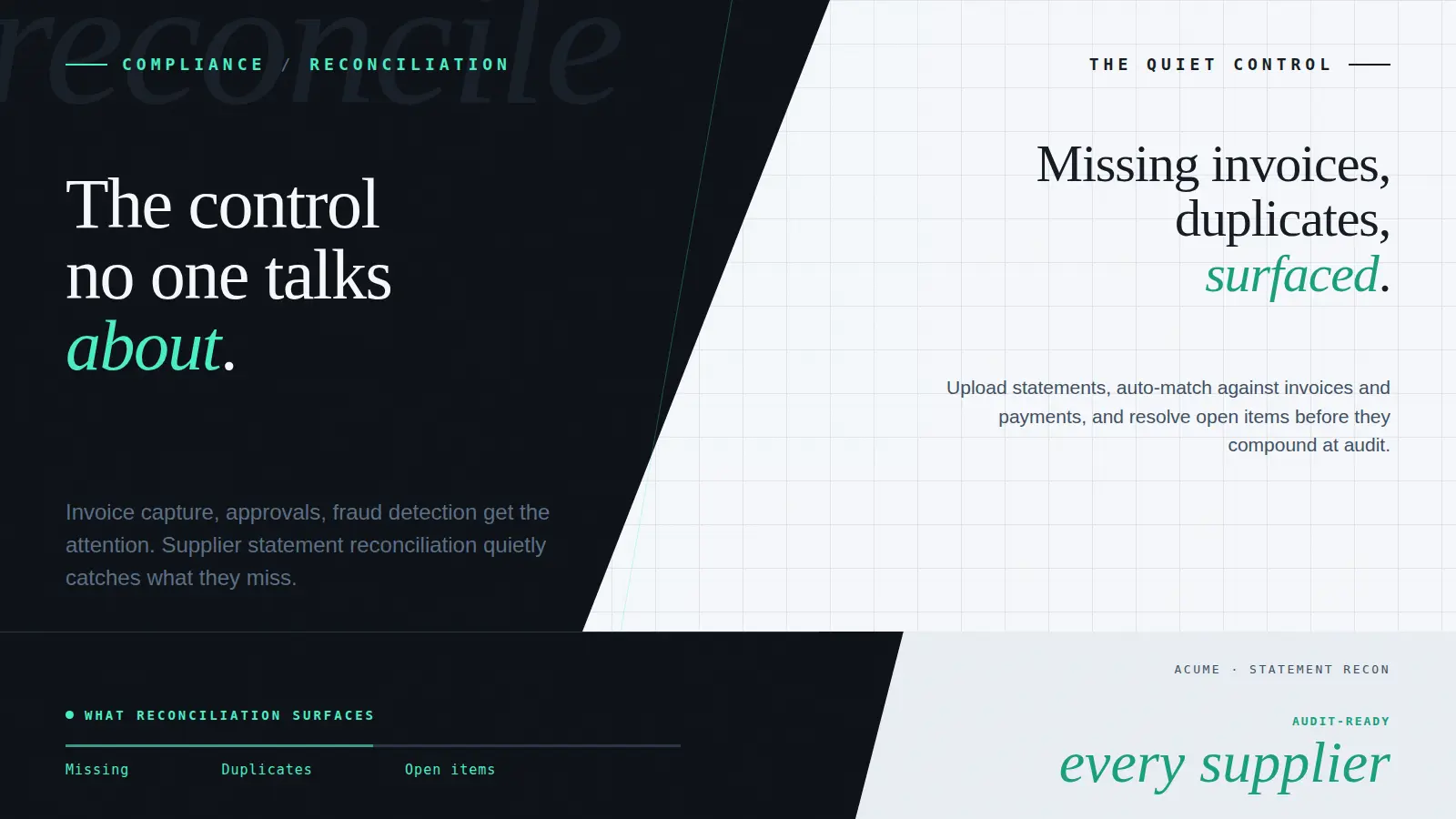
In accounts payable, some processes get all the attention. Invoice capture. Approval workflows. Fraud detection.
But there’s one control point that remains stubbornly in the shadows: supplier statement reconciliation.
Ask most finance leaders how much of their team’s time goes into it, and the answer is usually “not enough.” Ask why, and the response is often a mix of sighs and frustration.
The truth is that reconciling supplier statements is still often treated by many businesses as a box-ticking exercise, or worse, skipped altogether. Yet when overlooked, this “unloved” task can create financial leakage, compliance gaps, and supplier relationship risks that far outweigh the effort required to get it right.
It’s time to rethink supplier statement reconciliation as a strategic control in the AP process — and as a potential source of insight, not just admin.
What Supplier Statement Reconciliation Really Does
At its simplest, reconciliation is about comparing what a supplier says you owe against what’s in your system. However, beneath the surface, it plays a crucial role in maintaining financial integrity. Done well, it helps teams:
-
Catch missed invoices – statements may list invoices that were never included in the AP workflow.
-
Identify duplicate payments – mismatches can highlight invoices that slipped through twice.
-
Secure credit notes – suppliers may owe credits that aren’t visible without reviewing the statement.
-
Spot supplier errors – sometimes the mismatch isn’t on your side at all.
-
Provide audit assurance – reconciliations are evidence of robust financial controls.
In other words, reconciliation isn’t busywork. It’s an additional safety net that helps finance leaders sleep at night.
Why It’s Still Seen as a Burden
If reconciliation is so valuable, why do so many AP teams struggle to prioritise it?
1. Manual intensity
Supplier statements arrive in all shapes and sizes — PDFs, spreadsheets, emails. Each requires manual comparison against AP ledgers. For busy teams, this feels like drudgery.
2. Competing priorities
With pressure to close the month-end faster, reconciliation often gets bumped down the list. Invoice processing and payment scheduling take precedence.
3. Patchy coverage
Few organisations reconcile all supplier statements. High-value or high-volume suppliers may get attention, while smaller accounts slip through the cracks.
4. Lack of tools
Even businesses with automated invoice capture and approval workflows often lack equivalent tools for reconciliation. AP automation has advanced, but statement recs have lagged.
The result? Reconciliation is treated as “nice to have” rather than “must have.”
The Risks of Ignoring It
When reconciliation is inconsistent or absent, risks multiply:
-
Missed liabilities: If invoices aren’t in your system but appear on a supplier statement, you’re exposed to late fees, strained supplier relationships, and audit issues.
-
Lost credits: Failure to capture credit notes means unnecessary cash out the door.
-
Duplicate payments: Suppliers rarely chase overpayments. Without reconciliation, money can vanish silently.
-
Weaker audits: External auditors often test whether reconciliations are performed. Gaps can lead to findings and higher assurance costs.
-
Supplier trust erosion: If mismatches aren’t resolved proactively, suppliers may see your business as disorganised or unreliable.
Skipping reconciliation may save hours today — but it can cost days, dollars, and credibility tomorrow.
The Blind Spot in AP Automation
It’s worth asking why reconciliation hasn’t seen the same level of automation as invoice capture and approvals.
The challenge is inconsistency. Supplier statements are not standardised. Some are detailed line-by-line; others are summary totals. Formats differ wildly, even within industries.
This variability makes reconciliation harder to digitise. Unlike invoices, which follow predictable data patterns, statements require flexibility in interpretation. Until recently, the technology to handle this effectively at scale didn’t exist.
But this is changing. Advances in machine learning and rules-based validation are opening the door to scalable reconciliation automation. Just as AI can extract invoice data or propose GL codes, it can now be trained to read supplier statements, flag mismatches, and surface exceptions for human review.
From Admin to Insight
Perhaps the most exciting shift is in how reconciliation can evolve. Instead of being a chore done “because we have to,” reconciliation can become a source of intelligence:
-
Error profiling: Which suppliers consistently send statements that don’t match invoices? That’s a negotiation point or a process improvement target.
-
Credit recovery: Systematic reconciliation makes it easier to track down and recover supplier credits.
-
Spend visibility: Statements sometimes highlight patterns (such as seasonal surges or discount opportunities) that don’t surface in invoice-only workflows.
-
Risk management: Reconciliation provides early warning signals of supplier disputes, misbillings, or even fraud.
This turns reconciliation into a strategic lever — helping finance not just control spend, but understand it.
Where Acume’s Thinking Fits
While this is a thought leadership conversation, it’s worth noting that reconciliation isn’t something on the horizon – it’s already here.
At Acume, supplier statement reconciliation is a standard workflow for any customer processing AP. After all, if you’re managing payables properly, your system should already know about every invoice. Reconciliation is how you validate that integrity.
The key is automation with compliance in mind:
-
Standard guardrails: Rules ensure every mismatch, duplicate, or missing credit is caught.
-
Auditability: Each reconciliation is logged, stored, and available for future review.
-
Exception focus: The system handles the routine matching, so AP teams only review what doesn’t align.
This shifts reconciliation from a manual, low-value chore into a process that protects working capital and builds supplier confidence, all while reducing the effort for finance teams.
A Compliance-First Mindset
As with AI in AP generally, reconciliation automation works best with a compliance mindset. That means:
-
Automating the grunt work – statement reading, line matching, and exception surfacing.
-
Keeping humans in the loop – judgment and escalation where rules can’t decide.
-
Ensuring traceability – every decision logged, every mismatch recorded, every credit claimed.
The payoff is a process that is faster, more accurate, and less frustrating, but also safer, more compliant, and more strategically useful.
Final Thought
Supplier statement reconciliation will never be glamorous. But ignoring it is a false economy.
In a world where finance teams are asked to do more with less, reconciliation is a control that quietly protects working capital, strengthens supplier relationships, and enhances audit outcomes.
The future is not to bury it deeper in the back office. It’s to bring it into the automation conversation and to reimagine it as a source of intelligence, not just administration.
For finance leaders seeking to unlock the next layer of efficiency and insight, supplier statement reconciliation is the ideal starting point.
A demo on your actual workflow.
A live walkthrough using real data – the capture, the coding, the approval routing – and how it sits inside the AP workflow you already run. No slideware.