The cost of manually processing invoices can be surprisingly high.
Multiple studies have found that, on average, businesses spend between $25 and $30 per invoice when relying on manual entry, email handling, and exception resolution. These costs reflect the time it takes to handle documents physically, chase approvals, and fix errors.
In reality, your cost per invoice may be even higher.
At Acume, we’ve worked with clients whose “standard” invoice process required 13 different people to touch an invoice before it reached the payment queue, and that’s for invoices with no disputes or follow-up. This level of inefficiency is not uncommon in large organisations.
eInvoicing dramatically reduces this cost.
By delivering structured invoice data directly from the supplier into your accounts payable workflow, eInvoicing cuts out manual entry, scanning, and most error-prone steps. The result? Fewer delays, better data accuracy, and a leaner process.
On average, businesses save at least 60% per invoice by switching to eInvoicing.
Let’s talk real numbers:
According to the Ministry of Business, Innovation & Employment (MBIE):
-
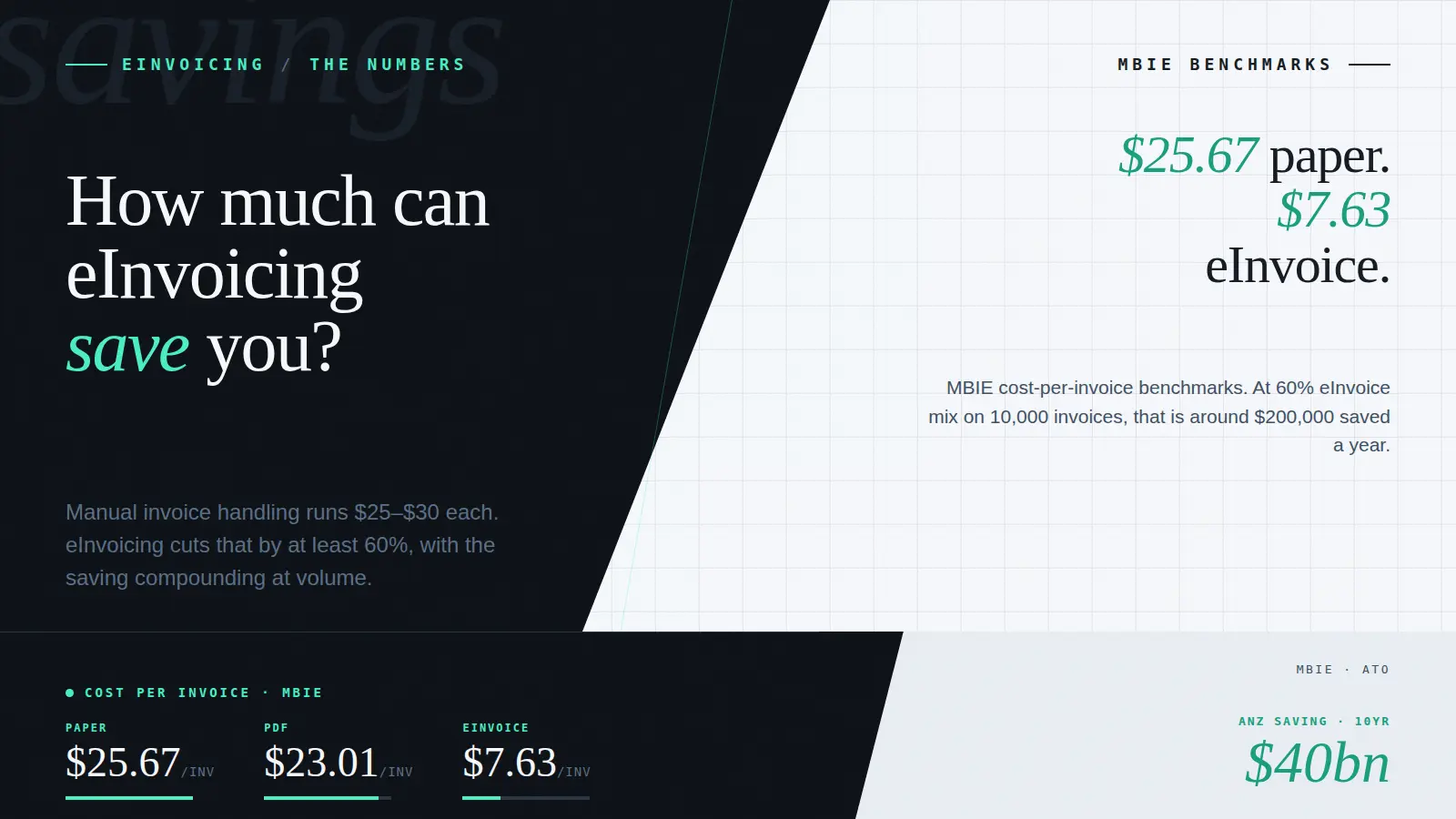
Paper invoice: $25.67
-
PDF invoice: $23.01
-
eInvoice: $7.63
Their ROI calculator allows you to model your own invoice volume. For example:
-
If your business processes 10,000 invoices per year and only 5% are eInvoices, you save $16,710 annually.
-
If 60% of your invoices are eInvoices, you save $200,520 per year.
The Australian Tax Office (ATO) estimates similar savings, $9 per eInvoice vs. $30 for paper or PDF, reflecting additional compliance layers in larger enterprises.
That’s why both Australia and New Zealand have adopted the Peppol eInvoicing standard and are promoting widespread use across government and private sectors. Over the next decade, businesses across both countries are expected to save over $40 billion.
Ready to reduce your invoice processing costs?
Talk to Acume—we’ll show you how to make eInvoicing work for your business.
Where to Go Next
- The Acume ROI calculator – put your own volumes through the model.
- The real cost of manual invoice processing – the cost-per-invoice benchmarks behind the business case.
- How to build a business case for AP automation – the full five-layer ROI framework.
- eInvoicing with Acume – the solution page, including Peppol access.
A demo on your actual workflow.
A live walkthrough using real data – the capture, the coding, the approval routing – and how it sits inside the AP workflow you already run. No slideware.