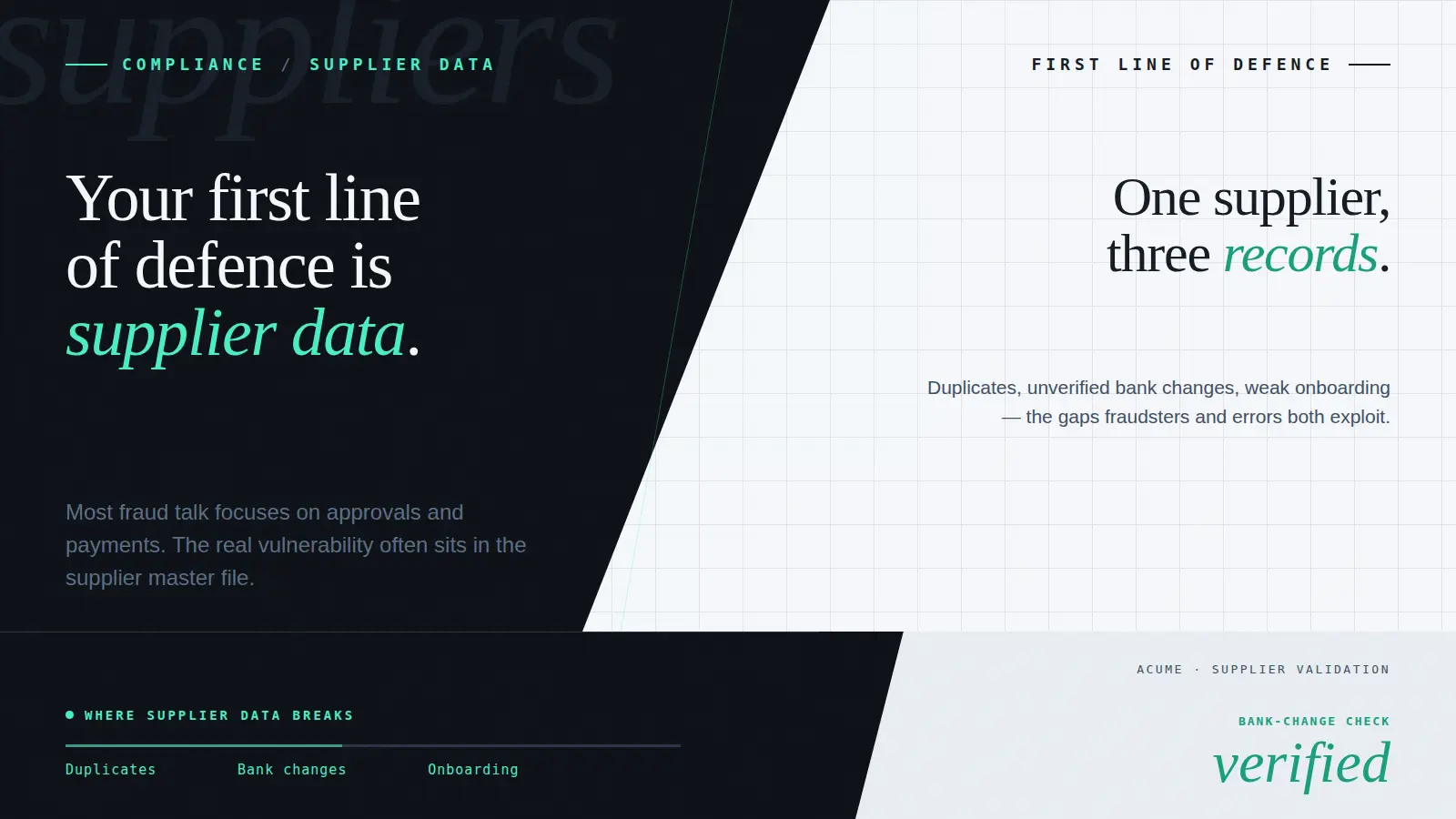
In the fast-evolving world of Accounts Payable (AP), most conversations about fraud prevention focus on invoice workflows, approval tiers, and payment controls. But the real vulnerabilities often sit further upstream, buried quietly in the supplier master file.
For growing businesses across Australia and New Zealand, this oversight can be costly. Payment-redirection scams, supplier impersonation, and tax mismatches don’t begin with the invoice. They begin with bad data, or worse, unverified data, in your supplier list.
The Hidden Risk: Supplier Master Data
In a typical mid-sized business, it’s not unusual to find:
- Supplier records with missing or outdated bank account details
- Duplicate supplier profiles for the same vendor
- Invoices processed against suppliers who were never properly vetted
- GST/IRD numbers that don’t align with the entity being paid
These gaps aren’t just administrative sloppiness; they’re attack surfaces for fraud. As businesses grow, they expand.
According to the Australian Competition and Consumer Commission (ACCC), over $227 million was lost to payment-redirection scams in 2021 alone, much of it enabled by incorrect or unverified supplier information. New Zealand’s CERT reports show similar patterns: business email compromise and supplier impersonation remain top threats year after year.
What Best Practice Looks Like in 2025
Modern AP automation doesn’t treat supplier data controls as a “nice to have”; they are foundational.
Here’s what best-in-class looks like:
- A supplier must exist in the supplier master file before an invoice is accepted.
- The bank account on the invoice must match what’s recorded against that supplier.
- The ABN/IRD number must align with the legal entity details in your system.
- New suppliers go through a controlled onboarding process, with verification steps and approval logs.
- Supplier changes (like bank updates) require dual approval and audit logging.
These are not features. They are guardrails. And yet, they are often missing in even the most digitised businesses.
Why This Gets Overlooked
It’s easy to assume your finance team has this under control, until a mistake happens:
- A junior staff member sets up a supplier using details from a phishing email.
- An old supplier changes banks, and someone updates the record based on a PDF.
- A duplicate record is created, bypassing a previous approval flow.
Each of these can result in a payment being misrouted or, worse, stolen.
The root problem? Many teams treat master data as a static list, not a living, controlled part of the financial process.
Acume’s Approach: Supplier Validation by Default
At Acume, we’ve built these validations into every customer workflow, not as an upgrade, but as a baseline.
- Invoices are rejected if the supplier isn’t recognised.
- Mismatched bank details? Flagged before posting.
- Tax identifiers are matched to the correct entity.
We believe that if you’re not validating supplier data as part of your AP process, you’re not just exposed you’re operating on luck.
The Payoff: Better Controls, Lower Risk
When supplier master data is actively managed and system-validated:
- Fraud risk plummets.
- Payment errors drop.
- Audits become faster and cleaner.
- Your finance team can focus on exception handling, not data wrangling.
And with eInvoicing and AP automation accelerating across the region, these controls are no longer just best practice—they are fast becoming expected practice.
Final Thought: Clean Data is Safe Money
If you’re investing in payment automation or approval workflows, but haven’t reviewed your supplier data policy in the last 12 months, start there.
Because no matter how sophisticated your invoice approval matrix is, it can all be undone by one incorrect bank account.
And the worst part? You might not even know it until it’s too late.
A demo on your actual workflow.
A live walkthrough using real data – the capture, the coding, the approval routing – and how it sits inside the AP workflow you already run. No slideware.