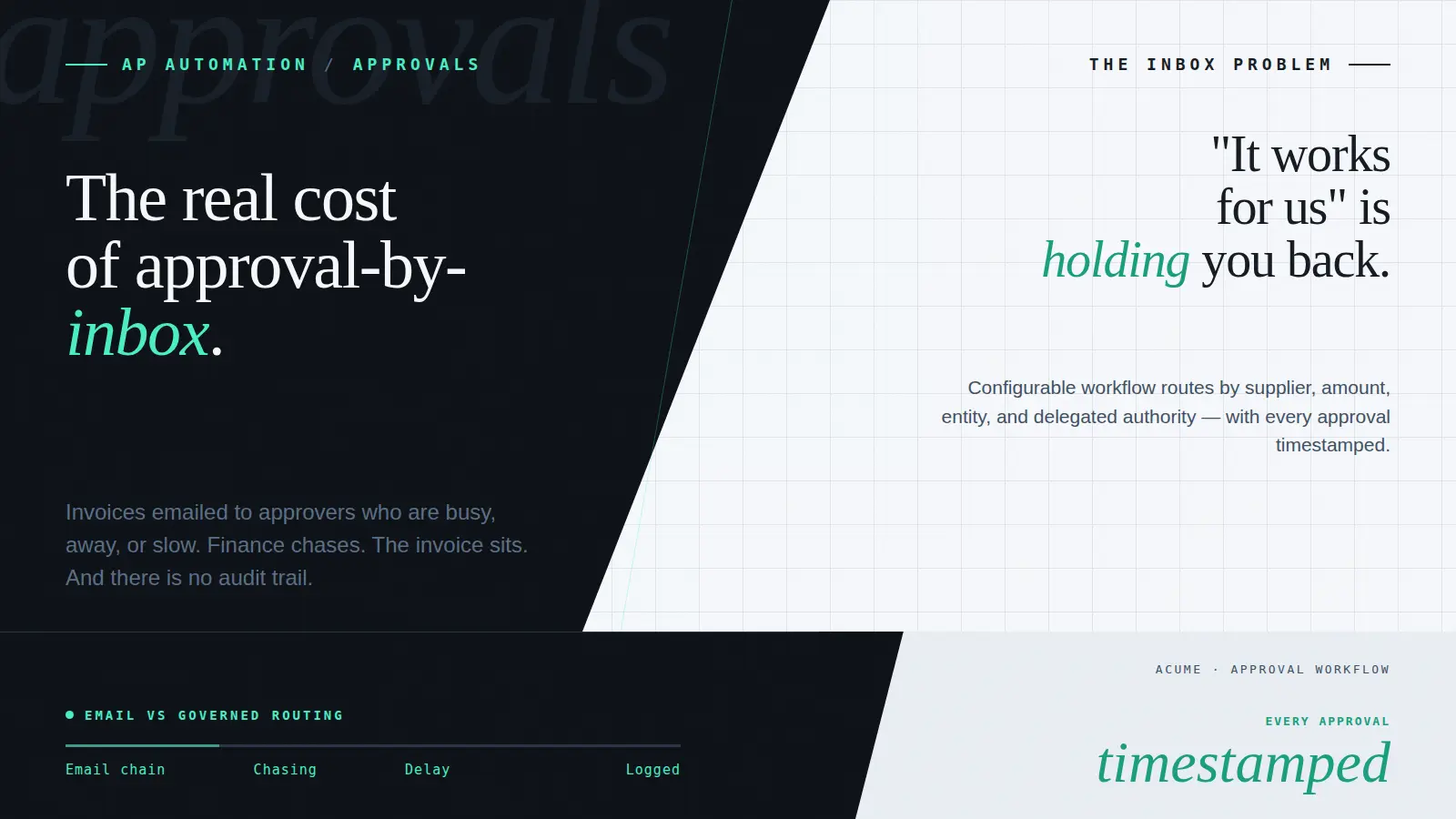
If you work in finance or operations, chances are you’ve seen it: a supplier invoice arrives, and it’s forwarded in an email to someone for approval. They reply with a quick “approved,” maybe a PDF is attached, and off it goes to accounts payable for processing.
It’s fast. It’s familiar. It works.
Until it doesn’t.
Behind that simple reply-all approval lies one of the most under-discussed weaknesses in SME finance: email-based invoice approvals. It’s a process that many teams fall into by default, and one that quietly compounds cost, risk, and inefficiency the longer it stays in place.
Let’s break down why this matters and examine what a modern, scalable alternative really looks like.
1. Email Approvals Aren’t a System, They’re a Workaround
Most SMEs don’t start out with formal AP workflows. When a business is small and agile, it’s easy to justify quick decisions: “Just flick me the invoice, I’ll sign off.”
But email, by nature, isn’t a workflow tool. It’s a communication channel. Once approval happens via email, the actual process of recording it becomes manual:
-
The AP team has to extract the approval and attach it to the invoice
-
There’s no validation that the approver had the right authority
-
There’s often no timestamped audit trail
-
It’s easy to miss or misplace messages
-
And if an invoice gets paid in error? There’s no structured way to trace the breakdown
Even if it’s “working” today, it won’t scale. Not when the business grows. Not when auditors ask questions. And definitely not when things go wrong.
2. Approval Bottlenecks Become AP’s Problem
Email approvals sound fast — until you look at what happens downstream.
A typical pattern looks like this:
“Hey John, can you approve this?”
[5 days pass. Month-end approaches.]
“Hi again, just checking if this is approved yet?”
Now the AP team is chasing approvals that live in someone else’s inbox. And when they don’t come through? Finance becomes the bottleneck.
Even worse, sometimes invoices do get approved late, but there’s no automatic match or status update in the system. It’s up to a human to reconcile that trail. Multiply this across dozens or hundreds of invoices per month, and it adds up to serious time, stress, and cost.
3. Visibility Disappears: Especially for Multi-Step Approvals
Let’s say an invoice over $5,000 needs two levels of approval. How do you track that in email?
-
Who’s responsible for escalating it?
-
How do you ensure the right sequence of approvals?
-
Can you see who has approved and who hasn’t – without asking?
The truth is, you can’t, not without a dedicated system. Finance ends up operating on assumptions and digging through threads to piece together accountability.
In larger or multi-entity businesses, this becomes a compliance risk. Approvals aren’t just an internal process — they’re a part of financial governance. And “we got it via email” doesn’t cut it when you’re audited.
4. You’re Missing a Real-Time Audit Trail
One of the most valuable and under-utilised benefits of a structured AP approval system is the audit trail.
With email, your “trail” consists of:
-
A screenshot
-
A saved PDF of an email chain
-
A note that “John approved it last week, I think”
Compare that to a proper audit-ready system:
-
Who approved it
-
When they approved it
-
Under what rule or delegated authority
-
Linked to the original invoice and payment
Not only is this a compliance best practice, it’s also essential for internal reviews, cross-charges, project spend monitoring, and dispute resolution.
5. It Feels Free, Because the Cost Is Hidden
Email feels cheap. But when you factor in:
-
Manual follow-ups
-
Delays in invoice processing
-
Errors from incorrect approvals
-
Time spent compiling documentation for audit
-
Missed early payment discounts or late fees
…the true cost becomes clear.
Email approvals represent a hidden drain on time and resources. The real kicker? These are avoidable costs. Every one of them exists because there’s no workflow doing the heavy lifting.
6. Why Teams Don’t Fix It (And What Changes That)
So why do businesses stick with email?
-
It’s what they’ve always done
-
They worry formal systems will slow things down
-
They haven’t hit a compliance issue yet
-
It feels “good enough”
The tipping point usually comes when:
-
Volume grows beyond what one person can track
-
Something goes wrong (a duplicate payment, a missing invoice, a fraud incident)
-
A new CFO or external auditor flags the gap
At that point, businesses do want control, but without sacrificing speed or simplicity. And that’s where modern AP platforms come in.
What a Scalable Approval Process Looks Like
It doesn’t mean bureaucracy. It doesn’t mean clunky tools. And it definitely doesn’t mean slowing down business.
A scalable invoice approval process should:
- Automatically route invoices based on value, department, project or GL
- Allow approvals on desktop or mobile
- Provide instant visibility on who’s approved what
- Keep a full audit trail — without extra effort
- Integrate with your accounting system for seamless reconciliation
That’s what modern AP automation, like Acume, is built for.
Rather than adding layers of admin, it removes the manual bits — so finance stays in control, without becoming the bottleneck.
Final Thoughts: From Fix-It Mode to Finance Leadership
Finance teams don’t exist just to process invoices. They exist to guide business decisions, protect cash flow, and ensure governance.
But that’s only possible when you’re not buried in email chains, chasing approvals that should be automatic.
Switching from email-based AP to a structured approval flow is one of the simplest, highest-impact changes a finance leader can make, especially before growth or audit pressure forces the issue.
Don’t wait until something breaks. Rethink the process now and have the finance lead from the front.
A demo on your actual workflow.
A live walkthrough using real data – the capture, the coding, the approval routing – and how it sits inside the AP workflow you already run. No slideware.