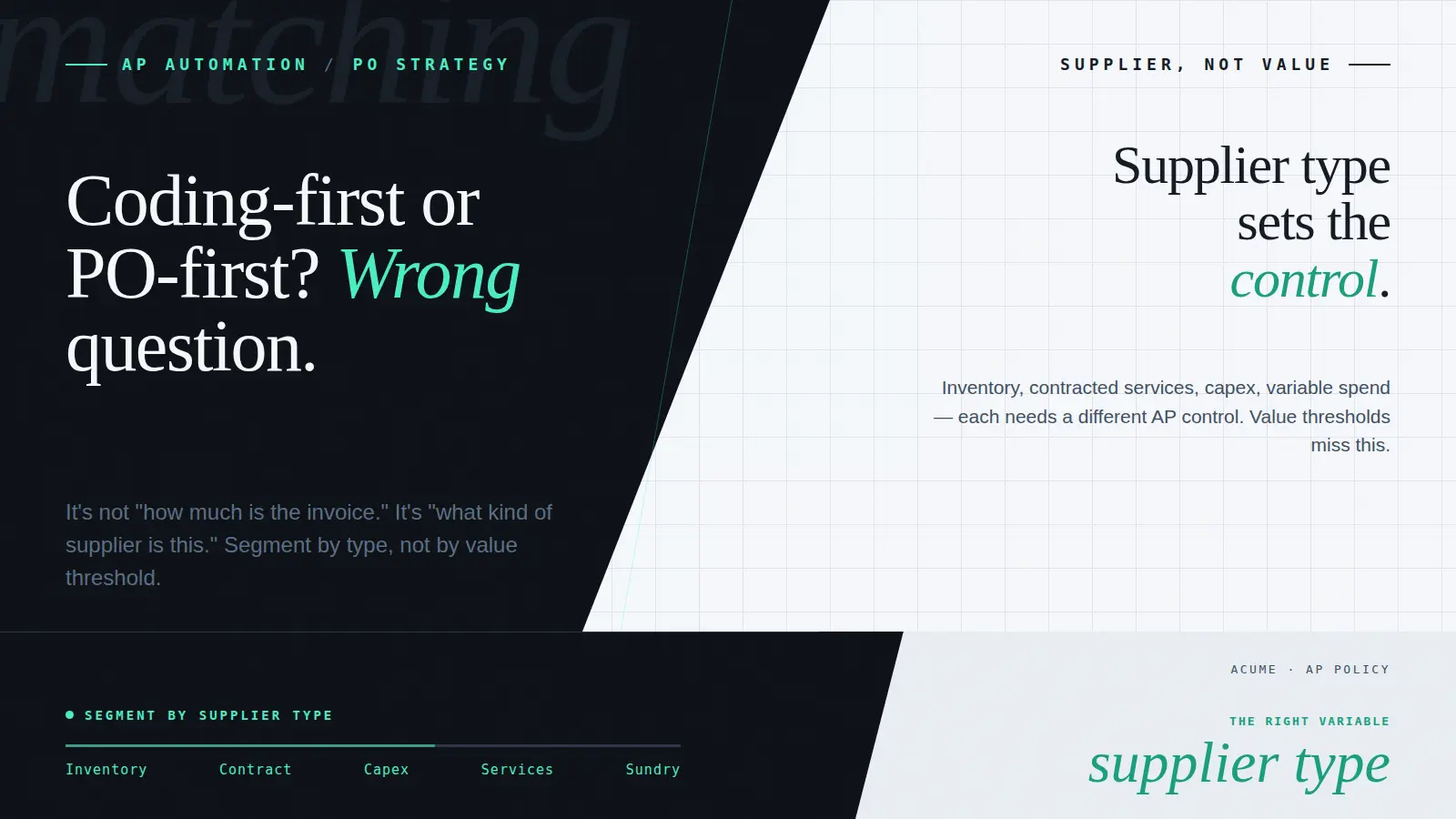
For finance leaders managing growth in Australia and New Zealand, deciding whether to implement a Purchase Order (PO)-based Accounts Payable (AP) process or continue with traditional post-invoice coding and approvals is critical. This white paper provides a structured analysis of these two distinct approaches, emphasizing the necessity of supplier segmentation over arbitrary invoice-value thresholds.
Understanding the Two Frameworks
1. Coding-First (Invoice-Based) Workflow
This traditional workflow involves: Receiving goods or services > receiving invoices from suppliers > coding and approving invoices after delivery.
Key Characteristics: – Timing: Controls implemented post-delivery. – Process: Manual coding and approval. – Financial Effort: Higher cost per invoice due to manual interventions and exceptions.
2. PO-First Workflow (Pre-Approved Commitment)
The PO-based workflow encompasses: – Creating a PO with coded spend before purchase. – Approval prior to supplier delivery. – Matching invoices automatically against the PO upon receipt.
Key Characteristics: – Timing: Upfront control before financial commitment. – Process: Streamlined through automation. – Financial Effort: Lower ongoing cost per invoice, despite initial administrative setup.
According to the State of ePayables 2023 report by Ardent Partners, organisations using PO-based automation and e-invoicing can achieve 60-80% cost reductions compared to manual AP environments.
Supplier Segmentation: The Correct Approach
Many organisations mistakenly adopt a value threshold, for instance, only requiring a PO for invoices above $1,000. This can create critical gaps, particularly with inventory-based purchases where:
- Inventory controls depend on accurate stock tracking.
- Small discrepancies cause significant stocktaking variances.
A more robust approach classifies suppliers based on purchase nature:
| Supplier Type | Typical Spend Profile | Recommended Control |
| Inventory or resale goods (manufacturers, distributors, hardware) | Predictable unit prices and volumes | Always PO-based for inventory accuracy |
| Capex & project suppliers (infrastructure, software) | Variable, milestone-driven | Hybrid Model: Initial PO with defined change-order approval thresholds |
| Contracted services (cleaning, maintenance, retainers) | Regular, budgeted spend | Blanket or recurring PO to streamline ongoing approvals |
| Variable services and sundry expenses (legal, consulting, travel) | Unpredictable, ad-hoc spend | Post-invoice approval is preferred for flexibility and efficiency |
Why Inventory Suppliers Demand PO-First Controls
Inventory Integrity
In ERP systems, inventory updates are triggered by PO receipts. Without a PO, stock levels become inaccurate, causing downstream reconciliation issues.
Contract Compliance
Automated PO matching immediately flags price or quantity discrepancies, preventing overpayments and ensuring supplier compliance.
Enhanced Fraud Protection
The Australian Competition and Consumer Commission (ACCC) reports significant losses due to payment-redirection scams ($227 million in 2021). PO workflows mitigate such risks by embedding supplier bank details into approval processes, providing additional security layers.
Improved Cashflow Forecasting
Open POs provide immediate visibility into future cash commitments, assisting strategic financial planning and cash flow management.
Scenarios Suited to Invoice-First Approval
Despite the benefits of PO workflows, certain transactions remain better suited to post-invoice approvals:
- Variable Professional Services: Legal or consulting fees that fluctuate with project scope.
- Emergency Repairs: Quick response requirements outweighing administrative rigour.
- Expense Claims and Corporate Cards: Transactions already completed by employees.
Critically, these decisions should always be supplier-driven, not dictated solely by transaction value.
Developing and Implementing Supplier-Based Policies
Step 1: Vendor Master Review
Segment active suppliers by nature of purchase: – Inventory – Services – Sundries
Step 2: Policy Formulation
Clearly define rules: – Inventory vendors: Mandatory PO regardless of transaction value. – Services vendors: Flexible approach based on transaction complexity and frequency.
Step 3: System Configuration
Leverage ERP and AP automation systems to enforce supplier-specific policies automatically, preventing policy bypass and ensuring compliance.
Step 4: Training and Communication
Educate procurement and AP teams on the rationale and practicalities of the new policy: – Clarify the supplier-type criteria. – Explain exception handling clearly.
Step 5: Ongoing Monitoring
Regularly review and adjust policies based on exception data: – Monitor unmatched invoices. – Evaluate supplier adherence. – Refine policies to enhance efficiency.
Overcoming Common Objections
- “POs slow transactions”: Modern ERP systems provide streamlined, quick-approval capabilities, significantly faster than managing post-transaction discrepancies.
- “Low-value invoices do not require POs”: For inventory suppliers, small-value invoices have significant impacts on inventory accuracy.
- “Suppliers won’t comply with PO numbers”: Supplier compliance can be achieved by embedding PO communications in the purchasing process, reinforced by ERP automation.
Realising Benefits and Ensuring Compliance
Organisations that adopt a strategic supplier-based PO approach consistently experience reduced invoice exceptions, faster processing times, improved inventory accuracy, and superior financial control. Additionally, these businesses benefit from better fraud prevention, reduced audit challenges, and improved stakeholder confidence.
Ardent Partners’ 2023 report highlights that high PO-invoice matching rates correlate directly with improved straight-through processing, reducing manual interventions and significantly lowering processing costs.
Recommended Actions for Finance Leaders
- Conduct a supplier spend analysis, identifying inventory-related vendors without existing PO processes.
- Implement a supplier-segmentation policy focused on purchase nature.
- Pilot supplier-specific PO controls, measuring efficiency improvements.
- Leverage technology such as e-invoicing to automate invoice matching and posting.
Conclusion
A nuanced, supplier-focused PO strategy ensures precise inventory management, stronger financial controls, and significant cost efficiencies. Rather than applying arbitrary transaction thresholds, organisations should adopt a deliberate, supplier-segmented approach. This ensures robust compliance, inventory accuracy, and greater operational effectiveness, positioning finance teams as strategic enablers of business growth and sustainability.
A demo on your actual workflow.
A live walkthrough using real data – the capture, the coding, the approval routing – and how it sits inside the AP workflow you already run. No slideware.