Introduction
In the world of finance operations, the phrase “100% automation” has become a kind of holy grail. It promises a future where invoices flow from supplier to payment without a single human touch, costs shrink dramatically, and finance teams can finally focus only on strategy.
It’s an attractive idea. But here’s the reality: very few organisations are in a position to achieve 100% automation – and those that chase it without laying the groundwork often end up disappointed.
Industry analysts back this up. Forrester’s 2025 analysis of AI in accounts payable shows that adoption is mature in areas like invoice data capture and matching, but still lagging in fraud detection, compliance, and reporting. In other words: some processes are ripe for near-touchless automation, but others remain stubbornly complex.
The lesson is clear: automation isn’t a magic switch. It’s a journey built on process, people, and technology working together.
The Allure of 100% Automation
Finance leaders are under pressure to do more with less – shrinking budgets, growing compliance demands, and a relentless drive for efficiency. Against that backdrop, the promise of “zero-touch” AP automation sounds irresistible.
It’s easy to see why:
-
Cost savings: Eliminate manual entry, approvals, and corrections.
-
Speed: Invoices move instantly from receipt to payment.
-
Control: Fewer errors and stronger compliance.
But analysts caution against taking the 100% promise at face value. The 2025 Gartner Magic Quadrant for Accounts Payable Applications notes that while some vendors excel in predictive coding and anomaly detection, no single solution delivers perfect end-to-end automation across all invoice types and business models.
The danger is that organisations assume the technology alone will deliver outcomes, while ignoring the messy reality of purchasing behaviour, data discipline, and exceptions. When those foundations are weak, the result isn’t perfection – it’s frustration.
What Best Practice Really Looks Like
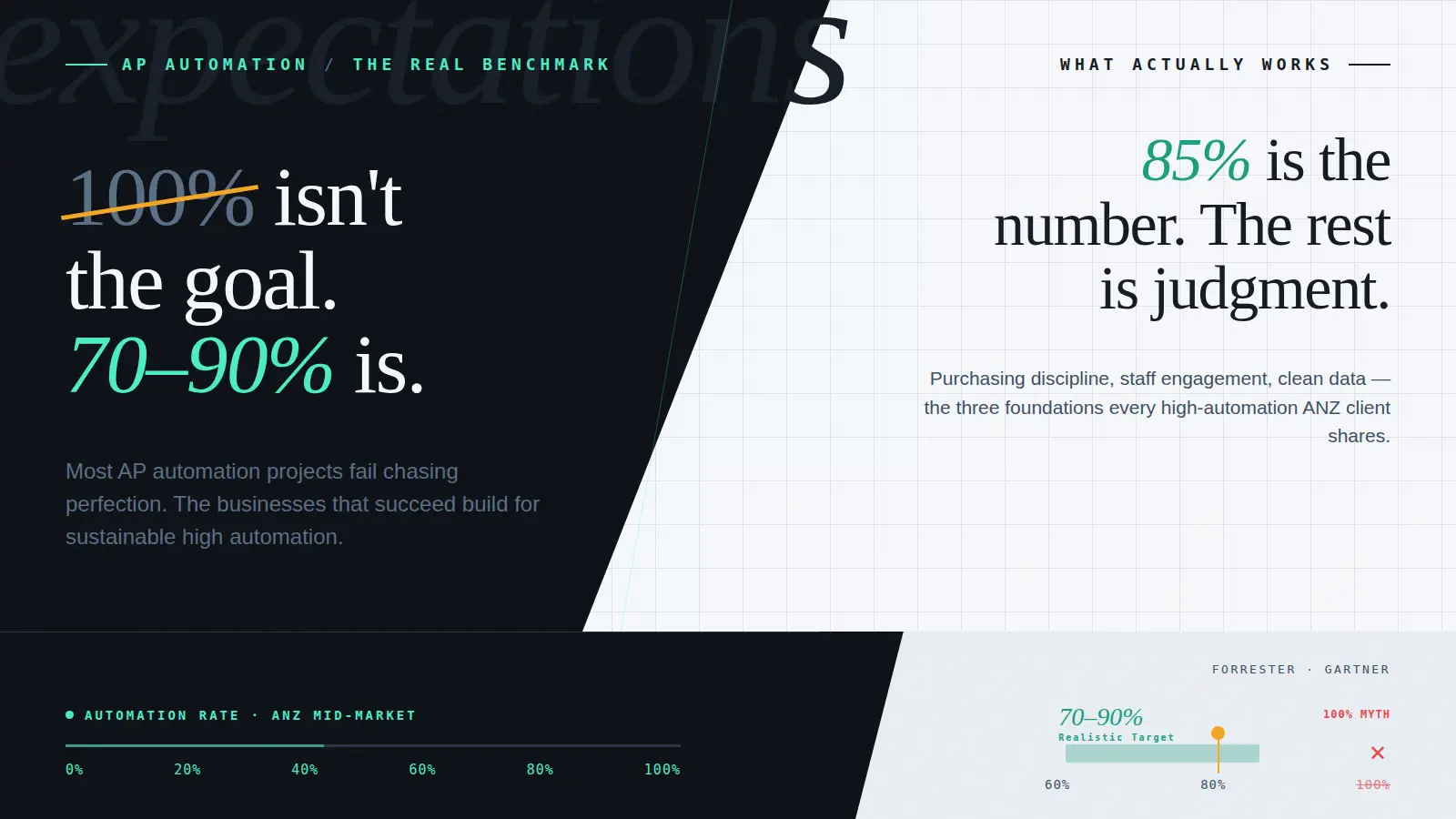
So what does success in AP automation look like today? Benchmarks suggest that 70–90% automation is realistic for mature organisations, especially in PO-driven environments.
At Acume, we’ve seen clients achieve around 85% automation for PO-to-invoice transactions. But this aligns with what external studies show as best practice: disciplined processes, engaged staff, and structured data.
Three common traits emerge across organisations that achieve high automation rates:
-
Purchasing discipline. Invoices consistently reference valid purchase orders, enabling accurate matching.
-
Staff engagement. Employees understand the “why” of the process and follow it.
-
Clean data. Supplier master data, PO formats, and coding standards are well-maintained.
Forrester’s adoption heatmaps confirm this—companies with strong process foundations see materially higher success rates in automation than those relying on technology alone.
Where the Technology Delivers
Technology has advanced significantly, and AP teams today have access to powerful automation tools.
-
Default coding: Recurring expenses (like rent, utilities, or subscriptions) can be auto-coded reliably.
-
AI-assisted coding: Machine learning models are being trained to recognise patterns and suggest coding automatically. It’s improving fast, though still not flawless.
-
Three-way matching: Where purchase orders, receipts, and invoices line up, automation can reliably close the loop without human intervention.
Here, external validation is strong. Gartner’s Market Guide for AP Invoice Automation notes that ML parsing of machine-readable documents can deliver accuracy rates in the high 90% range, provided the data inputs are clean and structured.
This reinforces that automation works beautifully where inputs are standardised. For many organisations, this means 70 – 90% of invoice volume can flow through with minimal human touch.
The Limits of Today’s Automation
But let’s be clear: 100% touchless AP automation is still out of reach for most businesses, and may be for some time. Why? Because exceptions exist.
-
Non-PO invoices. Ad hoc spending and services that bypass POs are notoriously harder to automate.
-
Complex spend categories. Professional services, construction, and one-off purchases often require interpretation or approvals.
-
Supplier data issues. Missing information, inconsistent formats, or incorrect coding can derail automation.
Forrester’s 2025 report shows that while data capture and PO matching are highly automated, fraud detection, e-invoicing compliance, and anomaly handling still require significant human oversight.
In other words, AI can help, but it isn’t flawless. Humans remain critical for judgment, compliance, and exception management.
How to Build the Foundations for Success
If 100% automation isn’t realistic, what should finance leaders aim for? The answer: build the right foundations, and let technology scale them.
-
Process alignment. Consistent PO usage, standardised approval workflows, and coding rules are the bedrock of AP success.
-
People investment. Training staff and creating a culture of process discipline pays dividends. Automation amplifies good behaviour—but it also magnifies bad habits.
-
Data discipline. Clean vendor master data, structured POs, and accurate coding standards ensure automation tools have reliable inputs.
These align with what advisory firms highlight as critical. Ramp, for example, lists data quality, integration complexity, and internal resistance as the most common causes of AP automation failure. Technology alone won’t fix these gaps.
Think of automation as the amplifier, not the instrument. Without a well-tuned foundation, it will simply make the noise louder.
Setting Realistic Expectations for ROI
So what should finance leaders expect in terms of outcomes?
-
Automation benchmarks. Industry research suggests that 70 – 90% of invoice volume can be automated in well-structured environments.
-
Beyond percentage automated. ROI should also be measured in:
-
Faster cycle times.
-
Reduced manual effort.
-
Stronger compliance and auditability.
-
Working capital improvements.
-
The business case is strong. A Forrester Total Economic Impact (TEI) study on mature AP Automation solution found a 158% ROI over three years, with productivity gains of ~50% among AP clerks and significant improvements in working capital.
These are tangible benefits—but they don’t require 100% automation to be achieved.
Conclusion: Chasing the Right Goal
The pursuit of 100% AP automation can be seductive. But the smarter goal is building the right combination of people, process, and technology to achieve high levels of automation where it matters most.
Gartner, Forrester, and other analysts all emphasise the same point: automation outcomes are uneven, maturity varies by process, and the biggest gains come when technology is built on strong process and data foundations.
At Acume, we’ve seen that when organisations focus on these foundations, 80–90% automation is achievable and sustainable. That level of efficiency transforms AP from a cost centre into a strategic enabler.
The question for finance leaders isn’t: “How do we get to 100%?”
It’s: “Are we building the right kind of automation success?”
A demo on your actual workflow.
A live walkthrough using real data – the capture, the coding, the approval routing – and how it sits inside the AP workflow you already run. No slideware.