Artificial intelligence has arrived in the back office. From invoice capture bots to machine learning models that “guess” where to code an expense, finance leaders are watching a flood of tools promise to take the pain out of accounts payable (AP).
It’s tempting to believe that AI will finally eliminate the friction of manual processing: no more typing in supplier names, no more hunting for the right GL code, no more chasing down approvals. But in practice, AI in finance is not magic. It is a fast-moving assistant, and like any assistant, it is only as good as the rules and context it works within.
The real challenge for CFOs and finance managers isn’t whether to use AI. It’s how to adopt AI without undermining the integrity of their finance processes.
The Allure of AI in Finance
The appeal is obvious. AI can:
-
Extract data from invoices at speed and scale.
-
Propose GL codes based on historical coding.
-
Match invoices to POs more efficiently than humans scanning line items.
All of these are labour-intensive steps that AP teams spend hours on every week. Automating them with AI could mean faster month-ends, reduced headcount pressure, and better supplier relationships.
This explains why many businesses are experimenting with “DIY AI.” Finance teams trial standalone models or build internal tools to speed up AP. The results can look promising at first.
When AI Guesses Wrong
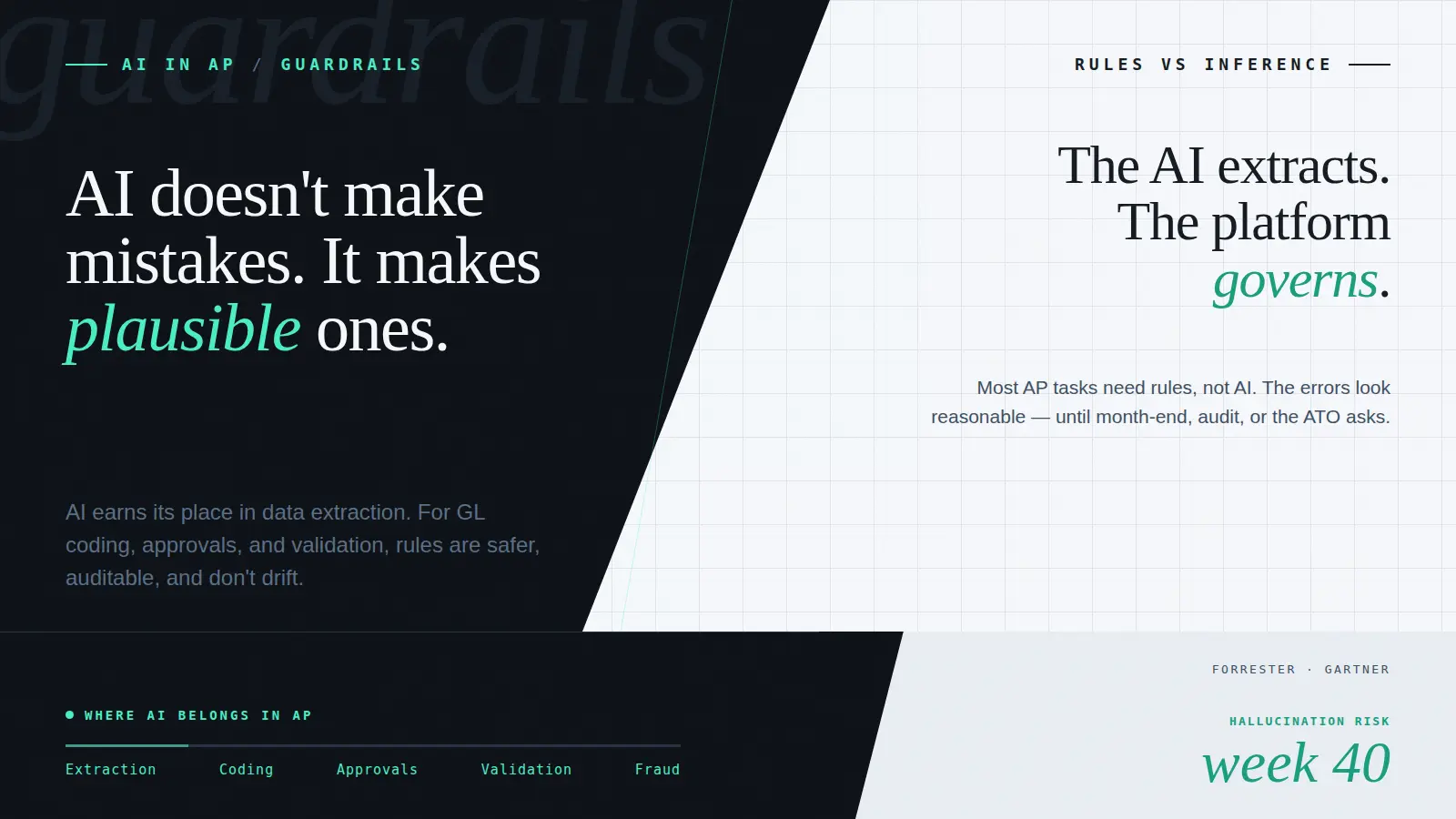
Here’s the problem: without proper guardrails, AI doesn’t just make mistakes, it makes plausible mistakes.
In one recent trial, AI was tasked with coding invoices. Faced with an expense type it hadn’t seen before, the model simply created a new GL code. Not only was this wrong, but it also undermined the chart of accounts, damaged reporting integrity, and created downstream reconciliation issues.
Another common failure point is tax handling. If GST or VAT isn’t coded correctly, AI may misapply tax rates or incorrectly exempt items. This isn’t just a reporting error; it can trigger compliance breaches, penalties, and rework during audits.
Other risks are just as serious:
-
False matches: AI incorrectly links an invoice to the wrong PO.
-
Audit gaps: AI tools without audit trails or retention policies.
-
Policy blind spots: AI approving spend that breaks company rules because it lacked context.
When AI is left to “guess,” it creates a new category of risk, one that is harder to detect because its outputs appear reasonable on the surface.
The Integrity Layer Finance Can’t Ignore
The lesson is clear: AI on its own isn’t enough. What matters is the integrity layer that surrounds it.
In finance, that means:
-
Business rules that guide every transaction.
-
Compliance frameworks that align with tax authorities, auditors, and regulators.
-
Audit trails and long-term storage that prove decisions years after the fact.
-
Tailored controls that reflect the unique chart of accounts and reporting structure of each business.
Without these, AI becomes an accelerant for error. With them, AI becomes an accelerator for efficiency.
Why Every Business Is Different
One often-overlooked fact: no two businesses code their accounts in the same way.
Even within the same industry, one company may treat freight costs as a direct expense while another codes them to COGS. Purchase reporting hierarchies vary. Departmental structures vary. Tax treatments vary.
That’s why a “one-size-fits-all” AI tool is dangerous in finance. The technology needs common guardrails to ensure compliance, but also the ability to adapt to the unique chart of accounts and policies of each business.
This balance between standardisation (the rails) and customisation (the switches) is what makes AI in finance viable at scale.
SaaS Platform vs. DIY AI
This is where the platform model diverges sharply from DIY experimentation.
-
A DIY AI project may work effectively in a lab environment, but it often lacks the necessary infrastructure for auditability, compliance, and scalability. There’s no guarantee that business rules are enforced. Outputs might be fast, but they’re ungoverned.
-
A SaaS AP platform with AI embedded brings the technology into a framework built for finance. Business rules, approval hierarchies, audit trails, and data retention are already established. AI operates within those boundaries, never outside them.
For finance leaders, the difference is stark: trust vs. risk.
Where AI Adds Value Today
Over the next six months, the most promising AI opportunities in AP sit in three areas:
-
Invoice Data Extraction
– AI accelerates capture, reducing reliance on templates and manual entry.
– Guardrails ensure supplier data is validated against known entities, reducing fraud risk. -
GL Coding
– AI suggests likely GL codes based on historical transactions.
– Business rules prevent “hallucinations” or the creation of invalid codes.
– Teams review and approve, saving time without ceding control. -
PO-to-Invoice Matching
– AI compares invoice line items to POs and receipts.
– Exceptions are flagged for human review, rather than wrongly approved.
– Long-term auditability ensures compliance with procurement policies.
Each of these is a rules-heavy process where AI can boost efficiency, but only if guided by a compliance framework.
A Compliance Mindset: The Only Sustainable Path
The real message for finance leaders is this: AI will not replace controls. It will depend on them.
Adopting AI with a compliance mindset means:
-
Setting the rails first. Define what can and can’t be coded, matched, or approved.
-
Designing for the long term. Ensure audit trails and storage align with statutory requirements.
-
Accepting that AI is an assistant, not the accountant. It suggests, flags, and accelerates, but doesn’t replace governance.
For businesses that get this right, the payoff is significant: faster AP cycles, reduced manual load, better reporting integrity, and the confidence to scale AI adoption without fear of “silent errors.”
Final Thought
AI in finance will only become more powerful. Models will get smarter. Accuracy rates will improve. Interfaces will get slicker. But the core truth won’t change:
Accounts payable is not just about processing transactions; it’s about protecting the financial integrity of the business. AI can help, but only if it operates within guardrails.
The future of AP is not AI alone. It’s AI plus platforms that enforce rules, preserve history, and adapt to each business’s unique way of working.
Finance leaders who chase speed without governance will find themselves untangling compliance problems. Those who embed AI within platforms designed for integrity will unlock efficiency without compromise.
A demo on your actual workflow.
A live walkthrough using real data – the capture, the coding, the approval routing – and how it sits inside the AP workflow you already run. No slideware.